A Flexible Iterative Framework for Consensus Clustering
Shaina Race, Carl D. Meyer
Abstract
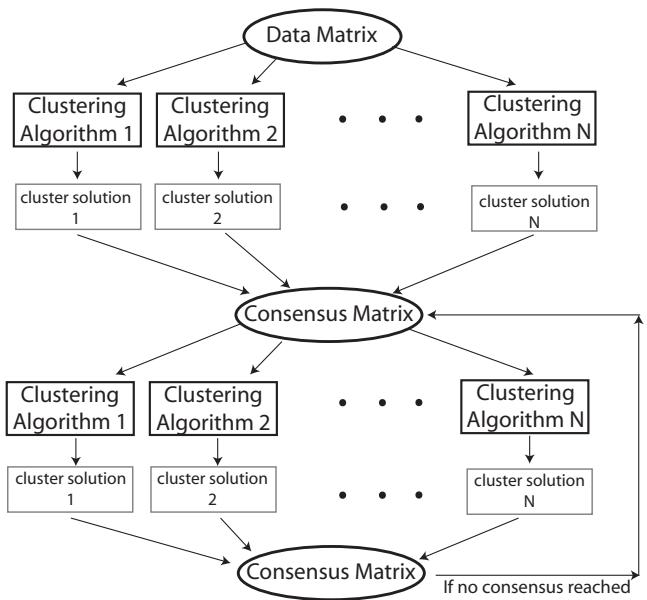
A novel framework for consensus clustering is presented which has the ability to determine both the number of clusters and a final solution using multiple algorithms. A consensus similarity matrix is formed from an ensemble using multiple algorithms and several values for k. A variety of dimension reduction techniques and clustering algorithms are considered for analysis. For noisy or high-dimensional data, an iterative technique is presented to refine this consensus matrix in way that encourages algorithms to agree upon a common solution. We utilize the theory of nearly uncoupled Markov chains to determine the number, k , of clusters in a dataset by considering a random walk on the graph defined by the consensus matrix. The eigenvalues of the associated transition probability matrix are used to determine the number of clusters. This method succeeds at determining the number of clusters in many datasets where previous methods fail. On every considered dataset, our consensus method provides a final result with accuracy well above the average of the individual algorithms.
§ The Valyu brief
Reading the full paper and taking notes. This takes a few seconds…
§ Ask this paper
Ask a question about this paper
Valyu reads the full text and answers from what the paper actually says.
Searching the other archives…