PolyMorph: Increasing P300 Spelling Efficiency by Selection Matrix Polymorphism and Sentence-Based Predictions
Alberto Casagrande, Joanna Jarmolowska, Marcello Turconi, Francesco Fabris, Pierpaolo Busan, Piero Paolo Battaglini
Abstract
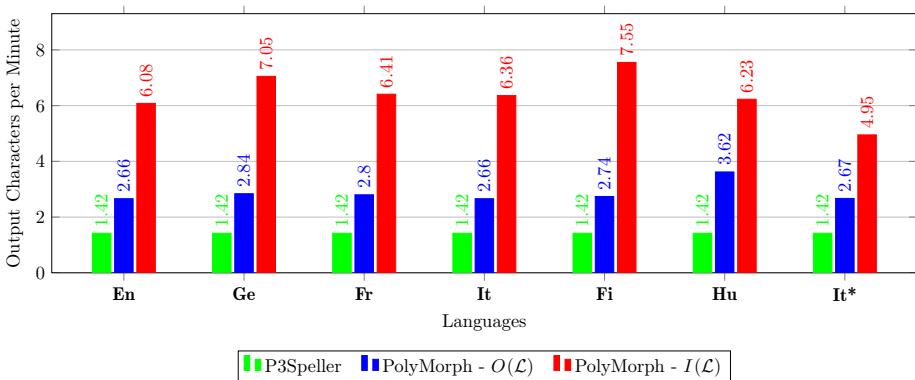
'Francesco Fabris' 'Pierpaolo Busan' 'Piero Paolo Battaglini'] P300 is an electric signal emitted by brain about 300 milliseconds after a rare, but relevant-for-the-user event. One of the applications of this signal is sentence spelling that enables subjects who lost the control of their motor pathways to communicate by selecting characters in a matrix containing all the alphabet symbols. Although this technology has made considerable progress in the last years, it still suffers from both low communication rate and high error rate. This article presents a P300 speller, named PolyMorph, that introduces two major novelties in the field: the selection matrix polymorphism, that reduces the size of the selection matrix itself by removing useless symbols, and sentence-based predictions, that exploit all the spelt characters of a sentence to determine the probability of a word. In order to measure the effectiveness of the presented speller, we describe two sets of tests: the first one in vivo and the second one in silico. The results of these experiments suggest that the use of PolyMorph in place of the naïve character-by-character speller both increases the number of spelt characters per time unit and reduces the error rate.
§ The Valyu brief
Reading the full paper and taking notes. This takes a few seconds…
§ Ask this paper
Ask a question about this paper
Valyu reads the full text and answers from what the paper actually says.
Searching the other archives…