A one-dimensional mathematical model of collecting lymphatics coupled with an electro-fluid-mechanical contraction model and valve dynamics
Christian Contarino, Eleuterio F. Toro
Abstract
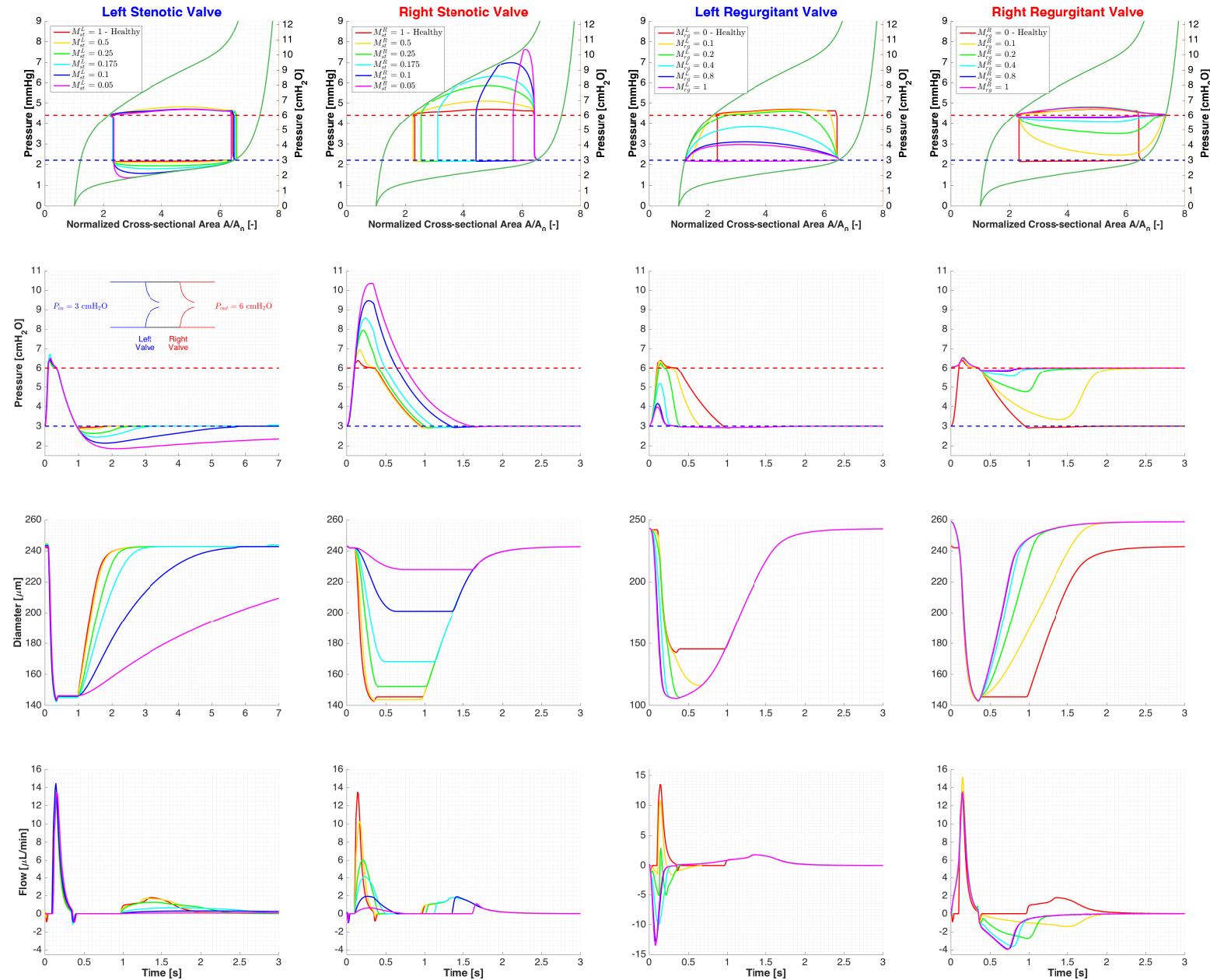
We propose a one-dimensional model for collecting lymphatics coupled with a novel Electro-Fluid-Mechanical Contraction (EFMC) model for dynamical contractions, based on a modified FitzHugh-Nagumo model for action potentials. The one-dimensional model for a compliant lymphatic vessel is a set of hyperbolic Partial Differential Equations (PDEs). The EFMC model combines the electrical activity of lymphangions (action potentials) with fluid-mechanical feedback (stretch of the lymphatic wall and wall shear stress) and the mechanical variation of the lymphatic wall properties (contractions). The EFMC model is governed by four Ordinary Differential Equations (ODEs) and phenomenologically relies on: (1) environmental calcium influx, (2) stretch-activated calcium influx, and (3) contraction inhibitions induced by wall shear stresses. We carried out a complete mathematical analysis of the stability of the stationary state of the EFMC model. Contractions turn out to be triggered by the instability of the stationary state. Overall, the EFMC model allows imitating the influence of pressure and wall shear stress on the frequency of contractions observed experimentally. Lymphatic valves are modelled using a well-established, versatile lumped-parameter model which allows simulating stenotic and regurgitant valves and quantifying their lymphodynamical effects. Modern numerical methods are employed for the one-dimensional model (PDEs), for the EFMC model and valve dynamics (ODEs). Adopting the geometrical structure of collecting lymphatics from rat mesentery, we show numerical tests inspired by experiments and also an example of a Riemann problem for lymphatics. We analysed several lymphodynamical indexes of a single lymphangion for a wide range of upstream and downstream pressure combinations where positive and negative pressure gradients are taken into account. The most influential model parameters were found by performing two sensitivity analyses for positive and negative pressure gradients. Stenotic and regurgitant valves were modelled, and their effects are here quantified.
§ The Valyu brief
Reading the full paper and taking notes. This takes a few seconds…
§ Ask this paper
Ask a question about this paper
Valyu reads the full text and answers from what the paper actually says.
Searching the other archives…