Recursive Multikernel Filters Exploiting Nonlinear Temporal Structure
Steven Van Vaerenbergh, Simone Scardapane, Ignacio Santamarı́a
Abstract
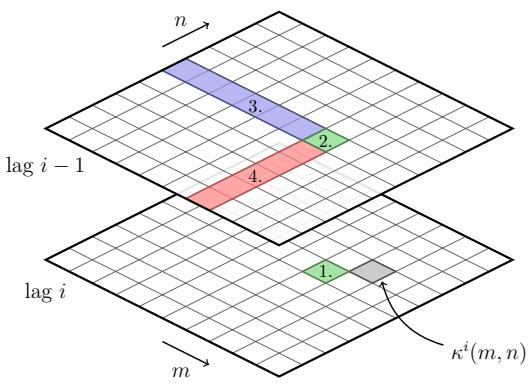
—In kernel methods, temporal information on the data is commonly included by using time-delayed embeddings as inputs. Recently, an alternative formulation was proposed by defining a γ-filter explicitly in a reproducing kernel Hilbert space, giving rise to a complex model where multiple kernels operate on different temporal combinations of the input signal. In the original formulation, the kernels are then simply combined to obtain a single kernel matrix (for instance by averaging), which provides computational benefits but discards important information on the temporal structure of the signal. Inspired by works on multiple kernel learning, we overcome this drawback by considering the different kernels separately. We propose an efficient strategy to adaptively combine and select these kernels during the training phase. The resulting batch and online algorithms automatically learn to process highly nonlinear temporal information extracted from the input signal, which is implicitly encoded in the kernel values. We evaluate our proposal on several artificial and real tasks, showing that it can outperform classical approaches both in batch and online settings.
§ The Valyu brief
Reading the full paper and taking notes. This takes a few seconds…
§ Ask this paper
Ask a question about this paper
Valyu reads the full text and answers from what the paper actually says.
Searching the other archives…