The control structure of the nematode Caenorhabditis elegans: neuro-sensory integration and propioceptive feedback
Charles Fieseler, James Kunert-Graf, J. Nathan Kutz
Abstract
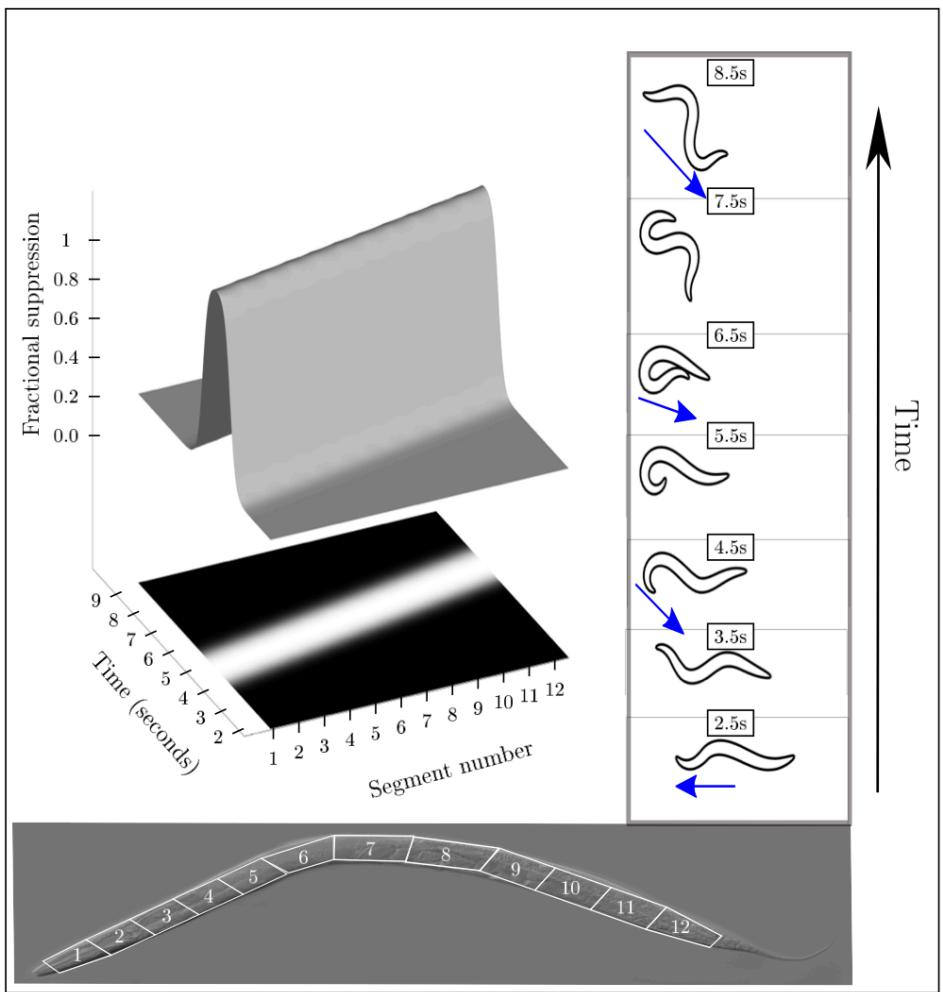
We develop a biophysically realistic model of the nematode C. elegans that includes: (i) its muscle structure and activation, (ii) key connectomic activation circuitry, and (iii) a weighted and time-dynamic proprioception. In combination, we show that these model components can reproduce the complex waveforms exhibited in C. elegans locomotive behaviors, chiefly omega turns. This is achieved via weighted, time-dependent suppression of the proprioceptive signal. Though speculative, such dynamics are biologically plausible due to the presence of neuromodulators which have recently been experimentally implicated in the escape response, which includes an omega turn. This is the first integrated neuromechanical model to reveal a mechanism capable of generating the complex waveforms observed in the behavior of C. elegans, thus contributing to a mathematical framework for understanding how control decisions can be executed at the connectome level in order to produce the full repertoire of observed behaviors.
§ The Valyu brief
Reading the full paper and taking notes. This takes a few seconds…
§ Ask this paper
Ask a question about this paper
Valyu reads the full text and answers from what the paper actually says.
Searching the other archives…