Spin and orbital structure of the first six holes in a silicon metal-oxide-semiconductor quantum dot
S. D. Liles, Ruoyu Li, Chih Hwan Yang, Fay E. Hudson, Menno Veldhorst, Andrew S. Dzurak, A. R. Hamilton
Abstract
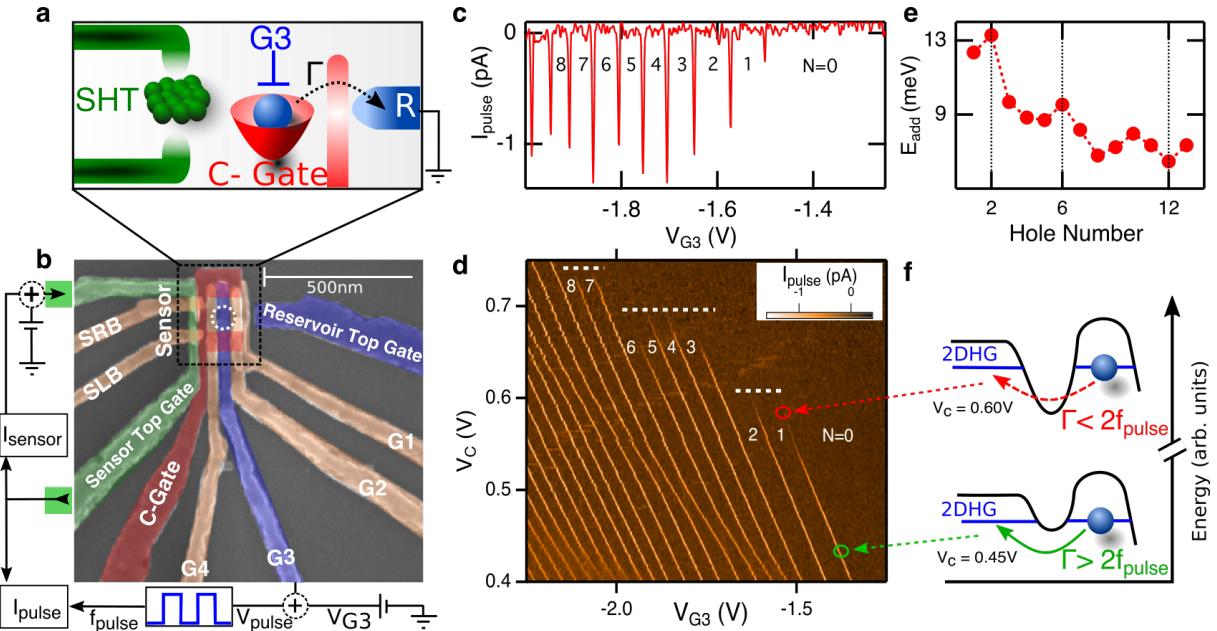
'Menno Veldhorst' 'Andrew S. Dzurak' 'A. R. Hamilton'] The spin states of electrons confined in semiconductor quantum dots form a promising platform for quantum computation 1–3 . Recent studies of silicon CMOS qubits have shown coherent manipulation of electron spin states with extremely high fidelity 4 . However, manipulation of single electron spins requires large oscillatory magnetic fields to be generated on-chip, making it difficult to address individual qubits when scaling up to multi-qubit devices4,5. The spinorbit interaction allows spin states to be controlled with electric fields, which act locally and are easier to generate6–8. While the spin-orbit interaction is weak for electrons in silicon, valence band holes have an inherently strong spin-orbit interaction. However, creating silicon quantum dots in which a single hole can be localised, in an architecture that is suitable for scale-up to a large number of qubits, is a challenge9–12. Here we report a silicon quantum dot, with an integrated charge sensor, that can be operated down to the last hole. We map the spin states and orbital structure of the first six holes, and show they follow the Fock-Darwin spectrum13,14. We also find that hole-hole interactions are extremely strong, reducing the two-hole singlet-triplet splitting by 90% compared to the single particle level spacing of 3.5 meV. These results provide a route to single hole spin quantum bits in a planar silicon CMOS architecture.
§ The Valyu brief
Reading the full paper and taking notes. This takes a few seconds…
§ Ask this paper
Ask a question about this paper
Valyu reads the full text and answers from what the paper actually says.
Searching the other archives…