A Multi-Scale Approach to Describe Electrical Impulses Propagating along Actin Filaments in both Intracellular and In-vitro Conditions
Christian Hunley, Diego Uribe, Marcelo Marucho
Abstract
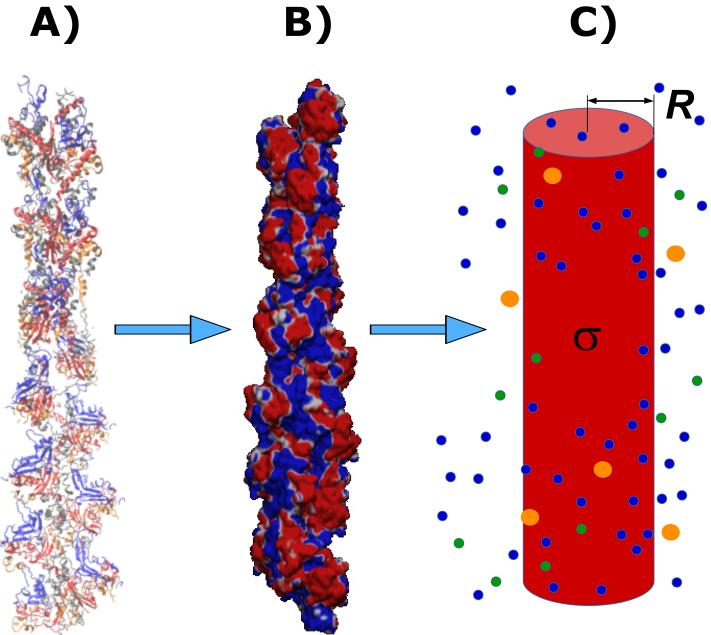
An accurate and efficient characterization of the polyelectrolyte properties for cytoskeleton filaments are key to the molecular understanding of electrical signal propagation, bundle and network formation, as well as other relevant physicochemical processes associated with biological functions in eukaryotic cells and their potential nanotechnological applications. In this article, we introduce an innovative multi-scale approach able to account for the atomistic details of a proteins molecular structure, its biological environment, and their impact on electrical impulses propagating along wild type Actin filaments. The approach provides a novel, simple, accurate, approximate analytic expression for the characterization of electrical impulses in the shape of soliton waveforms. It has been successfully used to determine the effects of electrolyte conditions and voltage stimulus on the electrical impulse shape, attenuation and kern propagation velocity in these systems. It has been shown that the formulation is capable of accounting for the details of electro-osmosis and convection, as well as the electrical double layer of G-actins includding the electrical conductivity and capacitance. The approach predicts higher electrical conductivity, linear capacitance and nonlinear accumulation of charge in intracellular condictions. Our results also show a siginificant influence of the voltage input on the electrical impulse shape, attenuation and propagation velocity. The filament is able to sustain the soliton propagation at almost constant kern velocity in the in-vitro condition, but the soliton displays a remarkable deceleration in the intracellular condition. Additionally, the solitons are narrower and travel faster at higher voltage input. Whereas, the voltage input does not play an important role on the soliton kern velocity in the in-vitro condition. Overall, Our results predict the propagation of electrical signal impulses in the form of solitons for the range of voltage stimulus and electrolyte solutions typically present in intracellular and in-vitro conditions.
§ The Valyu brief
Reading the full paper and taking notes. This takes a few seconds…
§ Ask this paper
Ask a question about this paper
Valyu reads the full text and answers from what the paper actually says.
Searching the other archives…