Evolutionary dynamics of cancer: From epigenetic regulation to cell population dynamics—mathematical model framework, applications, and open problems
Jinzhi Lei
Abstract
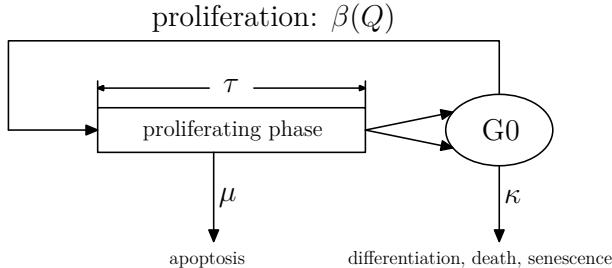
Predictive modeling of the evolutionary dynamics of cancer is a challenge issue in computational cancer biology. In this paper, we propose a general mathematical model framework for the evolutionary dynamics of cancer with plasticity and heterogeneity in cancer cells. Cancer is a group of diseases involving abnormal cell growth, during which abnormal regulations in stem cell regeneration are essential for the dynamics of cancer development. In general, the dynamics of stem cell regeneration can be simplified as a G0 phase cell cycle model, which lead to a delay differentiation equation. When cell heterogeneity and plasticity are considered, we establish a differential-integral equation based on the random transition of epigenetic states of stem cells during cell division. The proposed model highlights cell heterogeneity and plasticity, and connects the heterogeneity with cell-to-cell variance in cellular behaviors, e.g., proliferation, apoptosis, and differentiation/senescence, and can be extended to include gene mutation-induced tumor development. Hybrid computations models are developed based on the mathematical model framework, and are applied to the process of inflammation-induced tumorigenesis and tumor relapse after CAR-T therapy. Finally, we give rise to several mathematical problems related to the proposed differential-integral equation. Answers to these problems are crucial for the understanding of the evolutionary dynamics of cancer.
§ The Valyu brief
Reading the full paper and taking notes. This takes a few seconds…
§ Ask this paper
Ask a question about this paper
Valyu reads the full text and answers from what the paper actually says.
Searching the other archives…