Deep learning approaches for neural decoding: from CNNs to LSTMs and spikes to fMRI.
Jesse A. Livezey, Joshua I. Glaser
Abstract
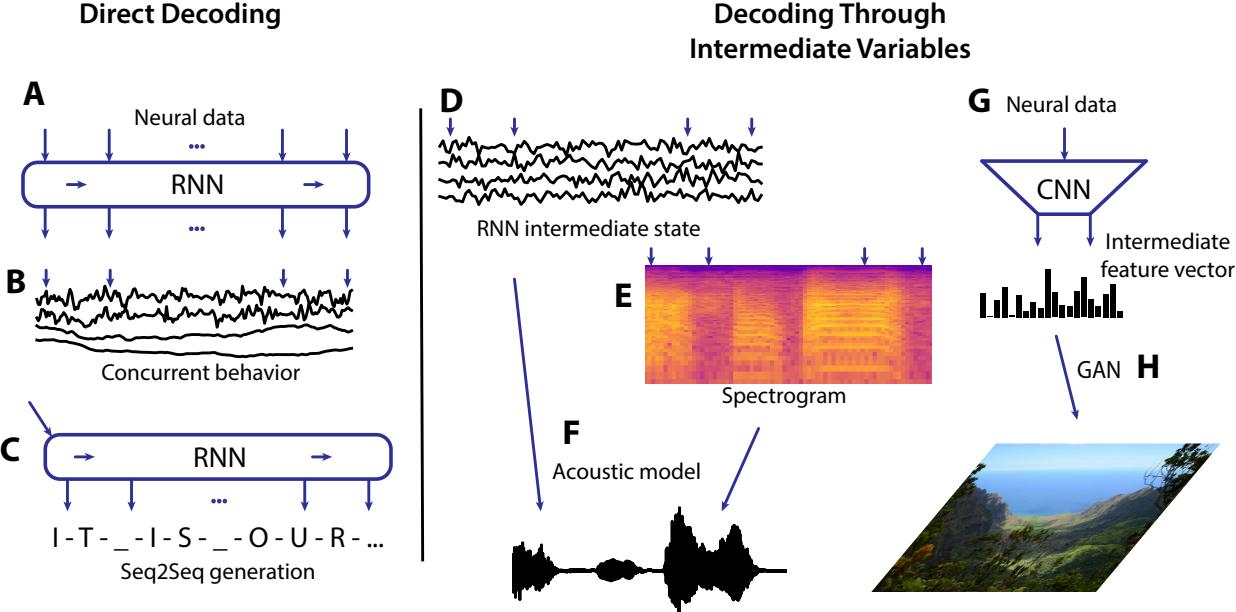
Decoding behavior, perception, or cognitive state directly from neural signals has applications in brain-computer interface research as well as implications for systems neuroscience. In the last decade, deep learning has become the state-of-the-art method in many machine learning tasks ranging from speech recognition to image segmentation. The success of deep networks in other domains has led to a new wave of applications in neuroscience. In this article, we review deep learning approaches to neural decoding. We describe the architectures used for extracting useful features from neural recording modalities ranging from spikes to EEG. Furthermore, we explore how deep learning has been leveraged to predict common outputs including movement, speech, and vision, with a focus on how pretrained deep networks can be incorporated as priors for complex decoding targets like acoustic speech or images. Deep learning has been shown to be a useful tool for improving the accuracy and flexibility of neural decoding across a wide range of tasks, and we point out areas for future scientific development.
§ The Valyu brief
Reading the full paper and taking notes. This takes a few seconds…
§ Ask this paper
Ask a question about this paper
Valyu reads the full text and answers from what the paper actually says.
Searching the other archives…