Hot isostatic pressing assisted diffusion bonding for application to the Super Proton Synchrotron internal beam dump at CERN
Stefano Pianese, Antonio Perillo‐Marcone, François‐Xavier Nuiry, M. Calviani, Krzysztof Adam Szczurek, G. Arnau Izquierdo, P. Avigni, S. Bonnin, Josep Busom Descarrega, T. Feniet, Keith Kershaw, J. Lendaro, A. Perez Fontenla, Thomas Schubert, S. Sgobba, Thomas Weißgärber
Abstract
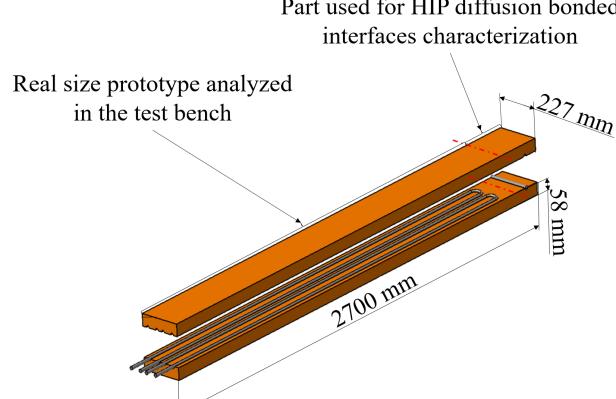
'M. Calviani' 'Krzysztof Adam Szczurek' 'G. Arnau Izquierdo' 'P. Avigni' 'S. Bonnin' 'Josep Busom Descarrega' 'T. Feniet' 'Keith Kershaw' 'J. Lendaro' 'A. Perez Fontenla' 'Thomas Schubert' 'S. Sgobba' 'Thomas Weißgärber'] The new generation internal beam dump of the Super Proton Synchrotron (SPS) at CERN will have to dissipate approximately 270 kW of thermal power, deposited by the primary proton beam. For this purpose, it is essential that the cooling system features a very efficient heat evacuation. Diffusion bonding assisted by Hot Isostatic Pressing (HIP) was identified as a promising method of joining the cooling circuits and the materials of the dump's core in order to maximise the heat transfer efficiency. This paper presents the investigation of HIP assisted diffusion bonding between two CuCr1Zr blanks enclosing SS 316L tubes and the realisation of a real size prototype of one of the dump's cooling plate, as well as the assessments of its cooling performance under the dump's most critical operational scenarios. Energy-dispersive X-ray (EDX) spectroscopy, microstructural analyses, measurements of thermal conductivity and mechanical strength were performed to characterize the HIP diffusion bonded interfaces (CuCr1Zr-CuCr1Zr and CuCr1Zr-SS 316L). A test bench allowed to assess the cooling performance of the real size prototype. At the bonded interface, the presence of typical diffusional phenomena was observed. Moreover, measured tensile strength and thermal conductivity were at least equivalent to the lowest ones of the materials assembled and comparable to its bulk properties, meaning that a good bonding quality was achieved. Finally, the real size prototype was successfully tested with an ad-hoc thermal test bench and with the highest operational thermal power expected in the new generation SPS internal beam dump.
§ The Valyu brief
Reading the full paper and taking notes. This takes a few seconds…
§ Ask this paper
Ask a question about this paper
Valyu reads the full text and answers from what the paper actually says.
Searching the other archives…