EEG-GCNN: Augmenting Electroencephalogram-based Neurological Disease Diagnosis using a Domain-guided Graph Convolutional Neural Network
Neeraj Wagh, Yogatheesan Varatharajah
Abstract
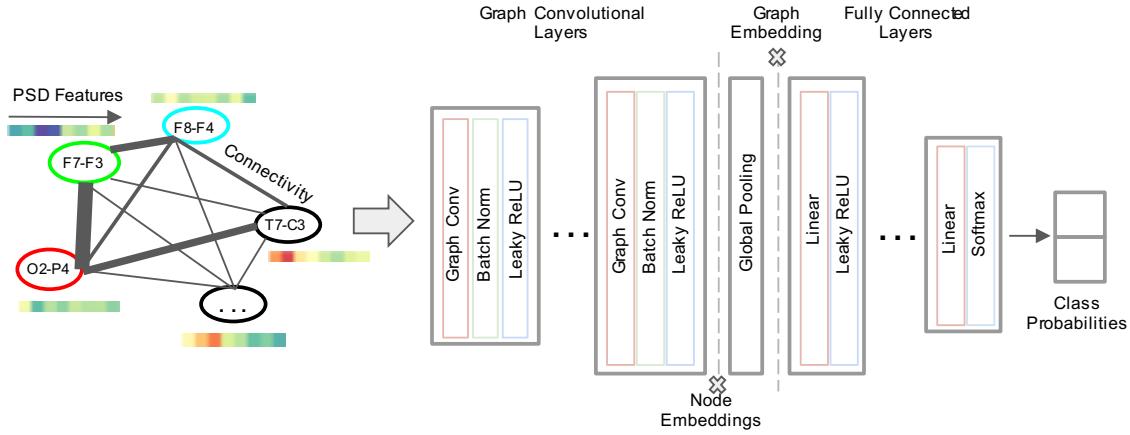
This paper presents a novel graph convolutional neural network (GCNN) based approach for improving the diagnosis of neurological diseases using scalp-electroencephalograms (EEGs). Although EEG is one of the main tests used for neurological-disease diagnosis, the sensitivity of EEG-based expert visual diagnosis remains at ∼50%. This indicates a clear need for advanced methodology to reduce the false negative rate in detecting abnormal scalp-EEGs. In that context, we focus on the problem of distinguishing the abnormal scalp EEGs of patients with neurological diseases, which were originally classified as 'normal' by experts, from the scalp EEGs of healthy individuals. The contributions of this paper are three-fold: 1) we present EEG-GCNN, a novel GCNN model for EEG data that captures both the spatial and functional connectivity between the scalp electrodes, 2) using EEG-GCNN, we perform the first large-scale evaluation of the aforementioned hypothesis, and 3) using two large scalp-EEG databases, we demonstrate that EEG-GCNN significantly outperforms the human baseline and classical machine learning (ML) baselines, with an AUC of 0.90. Keywords: EEG, Early diagnosis, Neurological disease, Graph CNN
§ The Valyu brief
Reading the full paper and taking notes. This takes a few seconds…
§ Ask this paper
Ask a question about this paper
Valyu reads the full text and answers from what the paper actually says.
Searching the other archives…