Clustered Sparse Channel Estimation for Massive MIMO Systems by Expectation Maximization-Propagation (EM-EP)
M. H. Rashid, Mort Naraghi‐Pour
Abstract
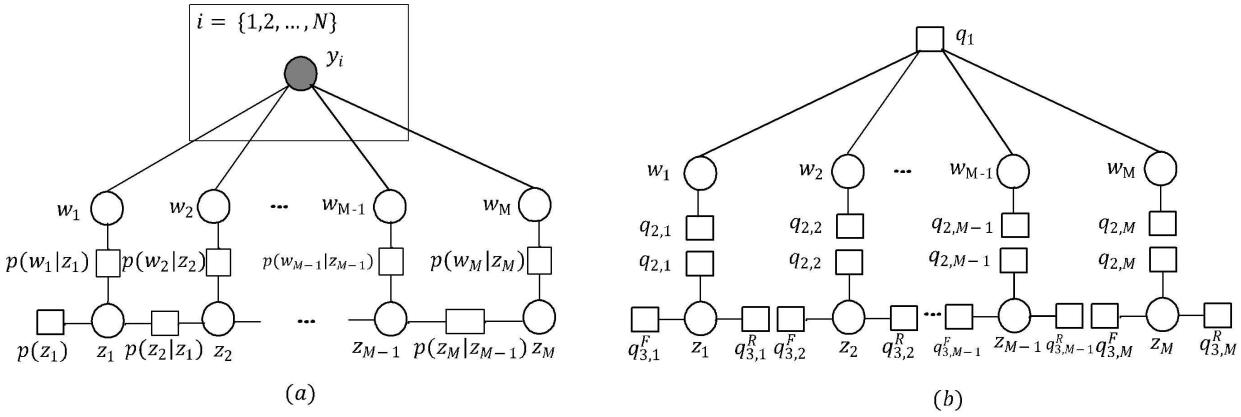
We study the problem of downlink channel estimation in multi-user massive multiple input multiple output (MIMO) systems. To this end, we consider a Bayesian compressive sensing approach in which the clustered sparse structure of the channel in the angular domain is employed to reduce the pilot overhead. To capture the clustered structure, we employ a conditionally independent identically distributed Bernoulli-Gaussian prior on the sparse vector representing the channel, and a Markov prior on its support vector. An expectation propagation (EP) algorithm is developed to approximate the intractable joint distribution on the sparse vector and its support with a distribution from an exponential family. The approximated distribution is then used for direct estimation of the channel. The EP algorithm assumes that the model parameters are known a priori. Since these parameters are unknown, we estimate these parameters using the expectation maximization (EM) algorithm. The combination of EM and EP referred to as EM-EP algorithm is reminiscent of the variational EM approach. Simulation results show that the proposed EM-EP algorithm outperforms several recently-proposed algorithms in the literature.
§ The Valyu brief
Reading the full paper and taking notes. This takes a few seconds…
§ Ask this paper
Ask a question about this paper
Valyu reads the full text and answers from what the paper actually says.
Searching the other archives…