A heuristic-driven uncertainty based ensemble framework for fake news detection in tweets and news articles
Sourya Dipta Das, Ayan Basak, Saikat Dutta
Abstract
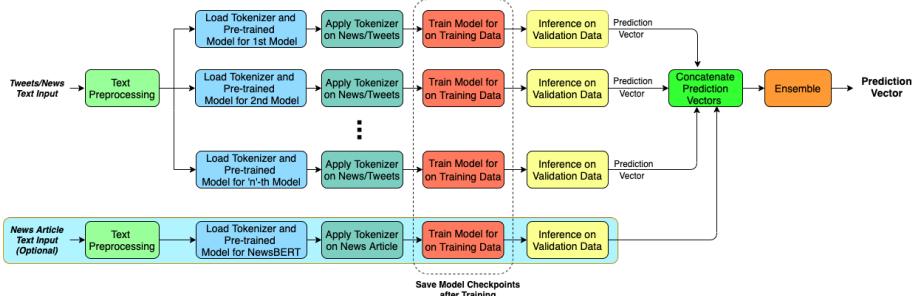
The significance of social media has increased manifold in the past few decades as it helps people from even the most remote corners of the world to stay connected. With the advent of technology, digital media has become more relevant and widely used than ever before and along with this, there has been a resurgence in the circulation of fake news and tweets that demand immediate attention. In this paper, we describe a novel Fake News Detection system that automatically identifies whether a news item is "real" or "fake", as an extension of our work in the CONSTRAINT COVID-19 Fake News Detection in English challenge. We have used an ensemble model consisting of pre-trained models followed by a statistical feature fusion network , along with a novel heuristic algorithm by incorporating various attributes present in news items or tweets like source, username handles, URL domains and authors as statistical feature. Our proposed framework have also quantified reliable predictive uncertainty along with proper class output confidence level for the classification task. We have evaluated our results on the COVID-19 Fake News dataset and FakeNewsNet dataset to show the effectiveness of the proposed algorithm on detecting fake news in short news content as well as in news articles. We obtained a best F1-score of 0.9892 on the COVID-19 dataset, and an F1-score of 0.9156 on the FakeNewsNet dataset. Keywords: COVID-19, Language Model, Fake News, Ensemble, Heuristic, Uncertainty, Dropout, Bayesian Approximation
§ The Valyu brief
Reading the full paper and taking notes. This takes a few seconds…
§ Ask this paper
Ask a question about this paper
Valyu reads the full text and answers from what the paper actually says.
Searching the other archives…