Optimal Decision Theory for Diagnostic Testing: Minimizing Indeterminate Classes with Applications to Saliva-Based SARS-CoV-2 Antibody Assays
Paul N. Patrone, Prajakta Bedekar, Nora Pisanic, Yukari C. Manabe, David L. Thomas, Christopher D. Heaney, Anthony J. Kearsley
Abstract
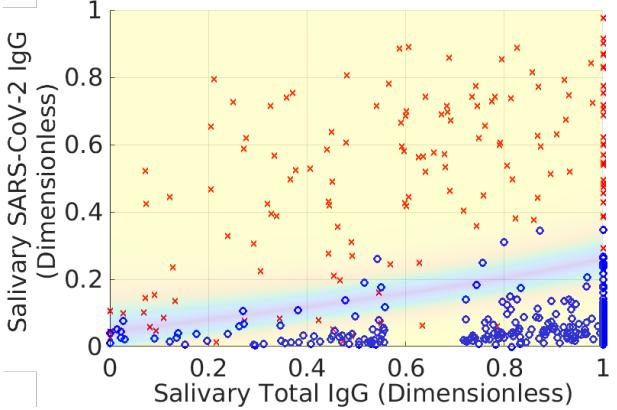
'David L. Thomas' 'Christopher D. Heaney' 'Anthony J. Kearsley'] Abstract In diagnostic testing, establishing an indeterminate class is an effective way to identify samples that cannot be accurately classified. However, such approaches also make testing less efficient and must be balanced against overall assay performance. We address this problem by reformulating data classification in terms of a constrained optimization problem that (i) minimizes the probability of labeling samples as indeterminate while (ii) ensuring that the remaining ones are classified with an average target accuracy X. We show that the solution to this problem is expressed in terms of a bathtub principle that holds out those samples with the lowest local accuracy up to an Xdependent threshold. To illustrate the usefulness of this analysis, we apply it to a multiplex, saliva-based SARS-CoV-2 antibody assay and demonstrate up to a 30 % reduction in the number of indeterminate samples relative to more traditional approaches.
§ The Valyu brief
Reading the full paper and taking notes. This takes a few seconds…
§ Ask this paper
Ask a question about this paper
Valyu reads the full text and answers from what the paper actually says.
Searching the other archives…