Structuro-elasto-plasticity (StEP) model for plasticity in disordered solids
Ge Zhang, Hongyi Xiao, Robert Ivancic, Entao Yang, Robert A. Riggleman, D. J. Durian, Andrea J. Liu
Abstract
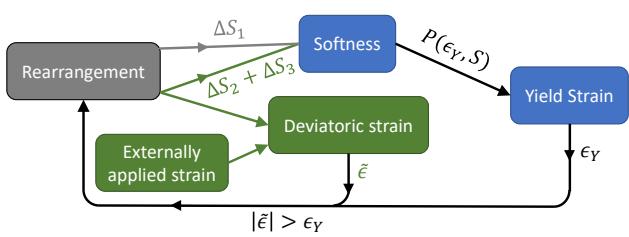
'Robert A. Riggleman' 'D. J. Durian' 'Andrea J. Liu'] Elastoplastic lattice models for the response of solids to deformation typically incorporate structure only implicitly via a local yield strain that is assigned to each site. However, the local yield strain can change in response to a nearby or even distant plastic event in the system. This interplay is key to understanding phenomena such as avalanches in which one plastic event can trigger another, leading to a cascade of events, but typically is neglected in elastoplastic models. To include the interplay one could calculate the local yield strain for a given particulate system and follow its evolution, but this is expensive and requires knowledge of particle interactions, which is often hard to extract from experiments. Instead, we introduce a structural quantity, "softness," obtained using machine learning to correlate with imminent plastic rearrangements. We show that softness also correlates with local yield strain. We incorporate softness to construct a "structuro-elasto-plasticity" model that reproduces particle simulation results quantitatively for several observable quantities, confirming that we capture the influence of the interplay of local structure, plasticity, and elasticity on material response.
§ The Valyu brief
Reading the full paper and taking notes. This takes a few seconds…
§ Ask this paper
Ask a question about this paper
Valyu reads the full text and answers from what the paper actually says.
Searching the other archives…