SpaDiT: Diffusion Transformer for Spatial Gene Expression Prediction using scRNA-seq
Xiaoyu Li, Fangfang Zhu, Wenwen Min
Abstract
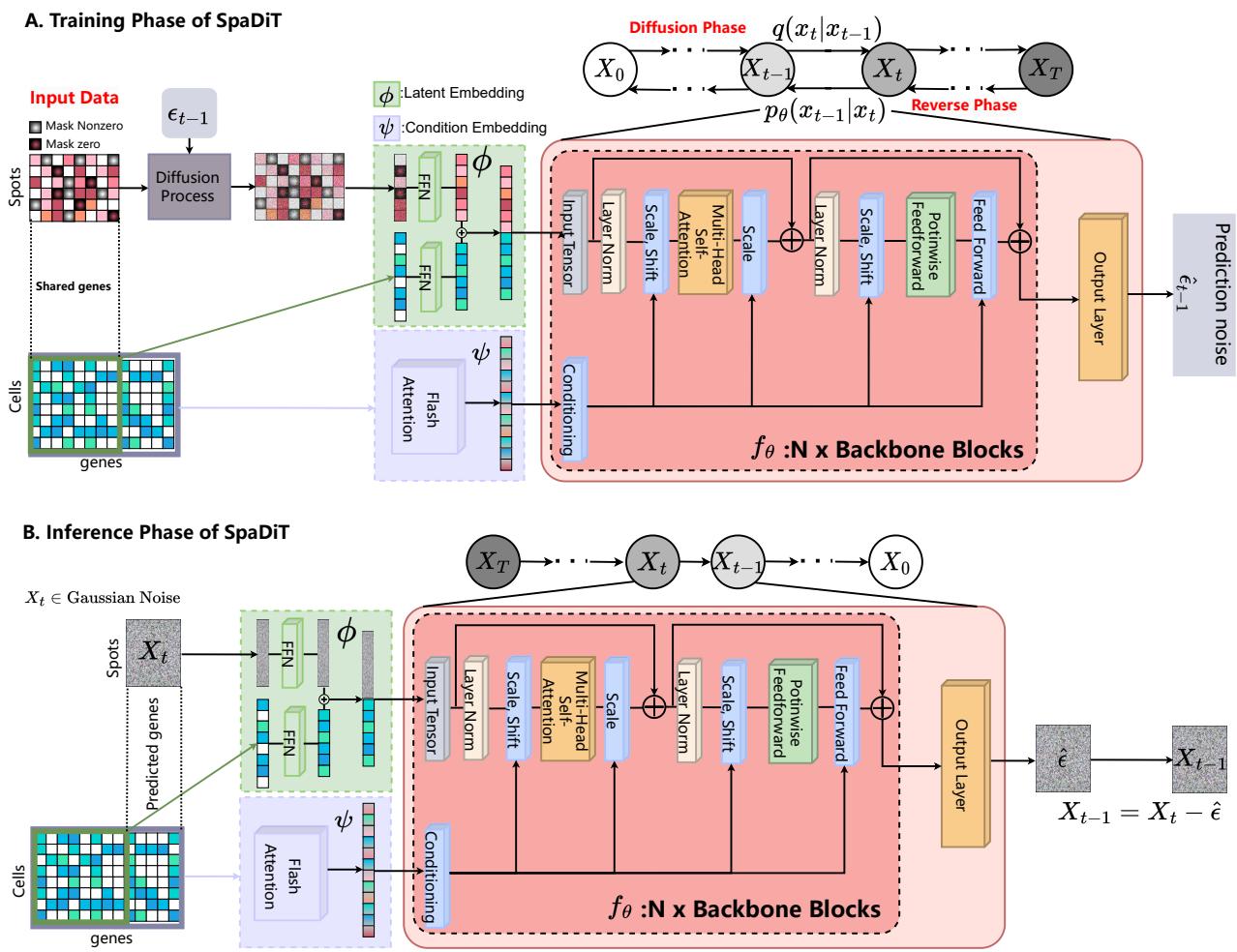
using scRNA-seq Authors: ['Xiaoyu Li' 'Fangfang Zhu' 'Wenwen Min'] The rapid development of spatial transcriptomics (ST) technologies is revolutionizing our understanding of the spatial organization of biological tissues. Current ST methods, categorized into next-generation sequencing-based (seq-based) and fluorescence in situ hybridization-based (image-based) methods, offer innovative insights into the functional dynamics of biological tissues. However, these methods are limited by their cellular resolution and the quantity of genes they can detect. To address these limitations, we propose SpaDiT, a deep learning method that utilizes a diffusion generative model to integrate scRNA-seq and ST data for the prediction of undetected genes. By employing a Transformer-based diffusion model, SpaDiT not only accurately predicts unknown genes but also effectively generates the spatial structure of ST genes. We have demonstrated the effectiveness of SpaDiT through extensive experiments on both seq-based and imagebased ST data. SpaDiT significantly contributes to ST gene prediction methods with its innovative approach. Compared to eight leading baseline methods, SpaDiT achieved state-of-the-art performance across multiple metrics, highlighting its substantial bioinformatics contribution.
§ The Valyu brief
Reading the full paper and taking notes. This takes a few seconds…
§ Ask this paper
Ask a question about this paper
Valyu reads the full text and answers from what the paper actually says.
Searching the other archives…