The mechanical properties of nerves, the size of the action potential, and consequences for the brain
Thomas Heimburg
Abstract
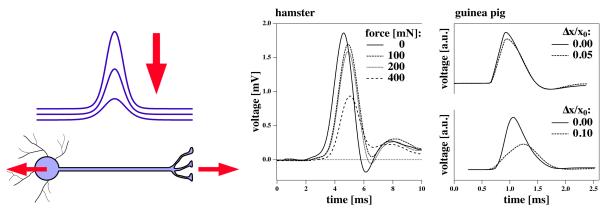
and consequences for the brain Authors: ['Thomas Heimburg'] ABSTRACT The action potential is widely considered a purely electrical phenomenon. However, one also finds mechanical and thermal changes that can be observed experimentally. In particular, nerve membranes become thicker and axons contract. The spatial length of the action potential can be quite large, ranging from millimeters to many centimeters. This suggests to employ macroscopic thermodynamics methods to understand its properties. The pulse length is several orders of magnitude larger than the synaptic gap, larger than the distance of the nodes of Ranvier, and even larger than the size of many neurons such as pyramidal cells or brain stem motor neurons. Here, we review the mechanical changes in nerves, theoretical possibilities to explain them, and implications of a mechanical nerve pulse for the neuron and for the brain. In particular, the contraction of nerves gives rise to the possibility of fast mechanical synapses.
§ The Valyu brief
Reading the full paper and taking notes. This takes a few seconds…
§ Ask this paper
Ask a question about this paper
Valyu reads the full text and answers from what the paper actually says.
Searching the other archives…