Planetary radio interferometry and Doppler experiment as an operational component of the Jupiter Icy Moons Explorer mission
Vidhya Pallichadath, Dominic Dirkx, Marie Fayolle, S. Frey, Leonid Gurvits, Paul Boven, Giuseppe Cimò, Judit Fogasy, Guifré Molera Calvés, Krisztina Perger, N. M. M. Said, Bert Vermeersen
Abstract
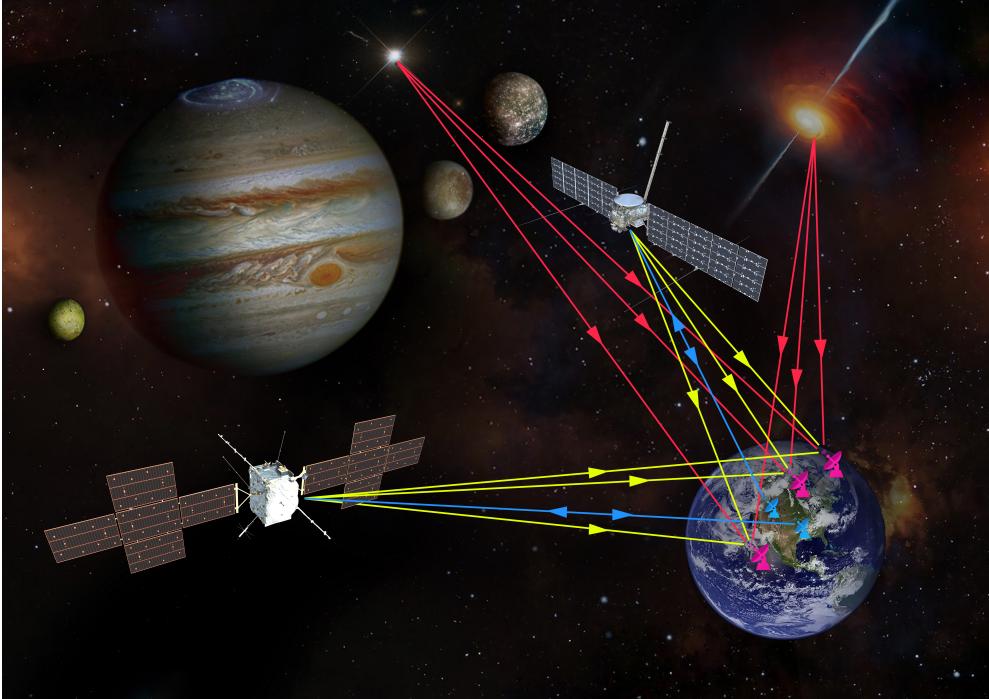
component of the Jupiter Icy Moons Explorer mission Authors: ['Vidhya Pallichadath' 'Dominic Dirkx' 'Marie Fayolle' 'S. Frey' 'Leonid Gurvits' 'Paul Boven' 'Giuseppe Cimò' 'Judit Fogasy' 'Guifré Molera Calvés' 'Krisztina Perger' 'N. M. M. Said' 'Bert Vermeersen'] We present an overview of the operations and engineering interface for Planetary Radio Interferometry and Doppler Experiment (PRIDE) radio astronomy observations as a scientific component of the ESA's Jupiter Icy Moons Explorer (JUICE) mission, as well as other prospective planetary and space science missions. The article discusses advanced scheduling and planning methods that make it possible to create observing schedules for observations of specific spacecraft in concurrence with observations of natural radio sources. In order to put this into practice and find suitable natural background calibrator sources for PRIDE of JUICE mission, we developed planning and scheduling software. The conventional scheduling software for natural celestial radio sources is not set up to include spacecraft as observation targets in the necessary control files. Therefore, difficulties already arise during observation planning. We report on the development of new and the adaptation of existing routines used in astrophysical and geodetic VLBI for satellite scheduling and planning. The analysis of the PRIDE science observations led to improved observational planning, and the mission's scheduling methodologies were studied using a systems engineering approach. In addition, we highlighted the new procedures, like finding charts for selecting calibrator radio sources over a range of frequency bands and the outcomes of those strategies for science operation planning. A simulation of the flyby of Venus during the cruise phase of the JUICE spacecraft, based on the Tudat software, is also presented, resulting in a promising opportunity to test PRIDE techniques and evaluate the improvements that PRIDE observables can make to natural bodies' ephemerides.
§ The Valyu brief
Reading the full paper and taking notes. This takes a few seconds…
§ Ask this paper
Ask a question about this paper
Valyu reads the full text and answers from what the paper actually says.
Searching the other archives…