ODesign: A World Model for Biomolecular Interaction Design
Zhang, Odin, Zhang, Xujun, Lin, Haitao, Tan, Cheng, Wang, Qinghan, Mo, Yuanle, Feng, Qiantai, Du, Gang, Yu, Yuntao, Jin, Zichang, You, Ziyi, Lin, Peicong, Zhang, Yijie, Tao, Yuyang, Chen, Shicheng, Chen, Jack Xiaoyu, Hua, Chenqing, Zhao, Weibo, Ma, Runze, Xia, Yunpeng, Ying, Kejun, Li, Jun, Zeng, Yundian, Lang, Lijun, Pan, Peichen, Cao, Hanqun, Song, Zihao, Qiang, Bo, Wang, Jiaqi, Ji, Pengfei, Bai, Lei, Zhang, Jian, Hsieh, Chang-yu, Heng, Pheng Ann, Sun, Siqi, Hou, Tingjun, Zheng, Shuangjia
Abstract
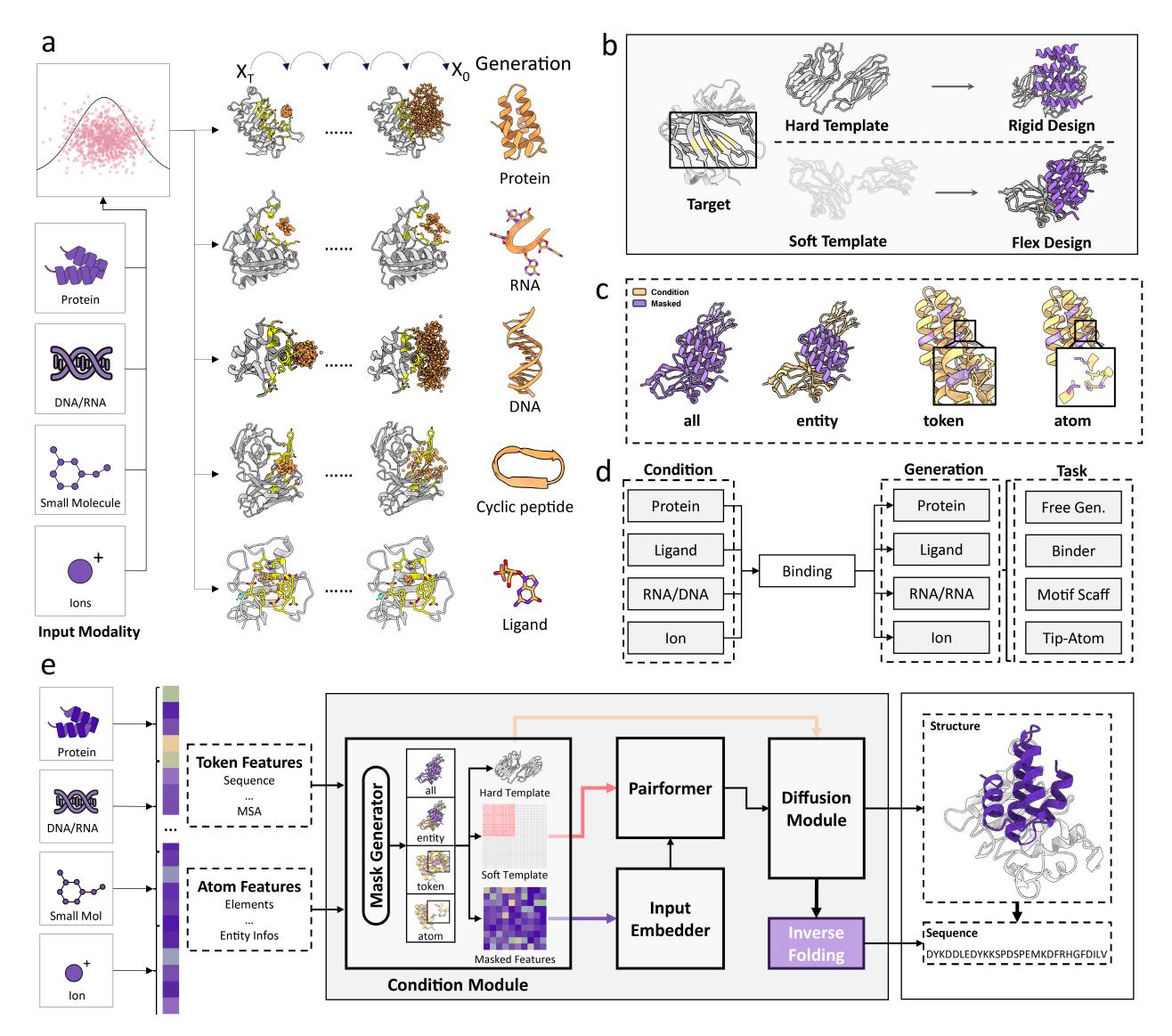
Biomolecular interactions underpin almost all biological processes, and their rational design is central to programming new biological functions. Generative AI models have emerged as powerful tools for molecular design, yet most remain specialized for individual molecular types and lack fine-grained control over interaction details. Here we present ODesign, an all-atom generative world model for all-to-all biomolecular interaction design. ODesign allows scientists to specify epitopes on arbitrary targets and generate diverse classes of binding partners with fine-grained control. Across entity-, token-, and atom-level benchmarks in the protein modality, ODesign demonstrates superior controllability and performance to modality-specific baselines. Extending beyond proteins, it generalizes to nucleic acid and small-molecule design, enabling interaction types such as protein-binding RNA/DNA and RNA/DNA-binding ligands that were previously inaccessible. By unifying multimodal biomolecular interactions within a single generative framework, ODesign moves toward a general-purpose molecular world model capable of programmable design. ODesign is available at , allowing users to generate binding partners without coding expertise.
§ The Valyu brief
Reading the full paper and taking notes. This takes a few seconds…
§ Ask this paper
Ask a question about this paper
Valyu reads the full text and answers from what the paper actually says.
Searching the other archives…