Modulation of temporal decision-making in a deep reinforcement learning agent under the dual-task paradigm
Pednekar, Amrapali, Álvaro Garrido-Pérez, Yara Khaluf, Pieter Simoens
Abstract
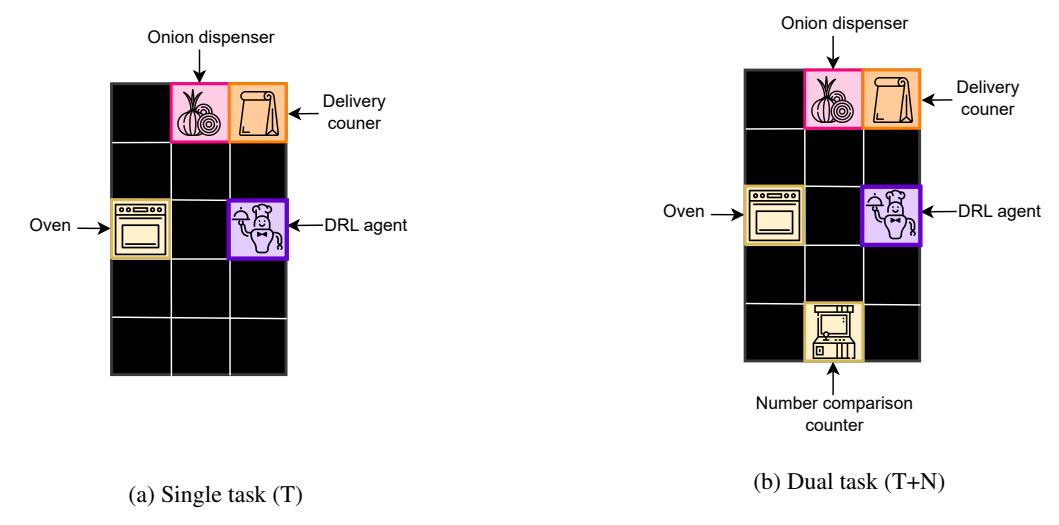
This study explores the interference in temporal processing within a dual-task paradigm from an artificial intelligence (AI) perspective. In this context, the dualtask setup is implemented as a simplified version of the Overcooked environment with two variations, single task (T) and dual task (T+N). Both variations involve an embedded time production task, but the dual task (T+N) additionally involves a concurrent number comparison task. Two deep reinforcement learning (DRL) agents were separately trained for each of these tasks. These agents exhibited emergent behavior consistent with human timing research. Specifically, the dual task (T+N) agent exhibited significant overproduction of time relative to its single task (T) counterpart. This result was consistent across four target durations. Preliminary analysis of neural dynamics in the agents' LSTM layers did not reveal any clear evidence of a dedicated or intrinsic timer. Hence, further investigation is needed to better understand the underlying time-keeping mechanisms of the agents and to provide insights into the observed behavioral patterns. This study is a small step towards exploring parallels between emergent DRL behavior and behavior observed in biological systems in order to facilitate a better understanding of both.
§ The Valyu brief
Reading the full paper and taking notes. This takes a few seconds…
§ Ask this paper
Ask a question about this paper
Valyu reads the full text and answers from what the paper actually says.
Searching the other archives…