Emergent togetherness in collaborative dance improvisation: neural and motor synchronization reveal a coupling-decoupling paradox
Yago Emanoel Ramos, Raphael Silva do Rosário, Adriana de Faria Gehres, Maria João Alves, Ana Maria Leitão, Cecília Bastos da Costa Accioly, Fátima Wachowicz, Ivani Santana, José García Vivas Miranda
Abstract
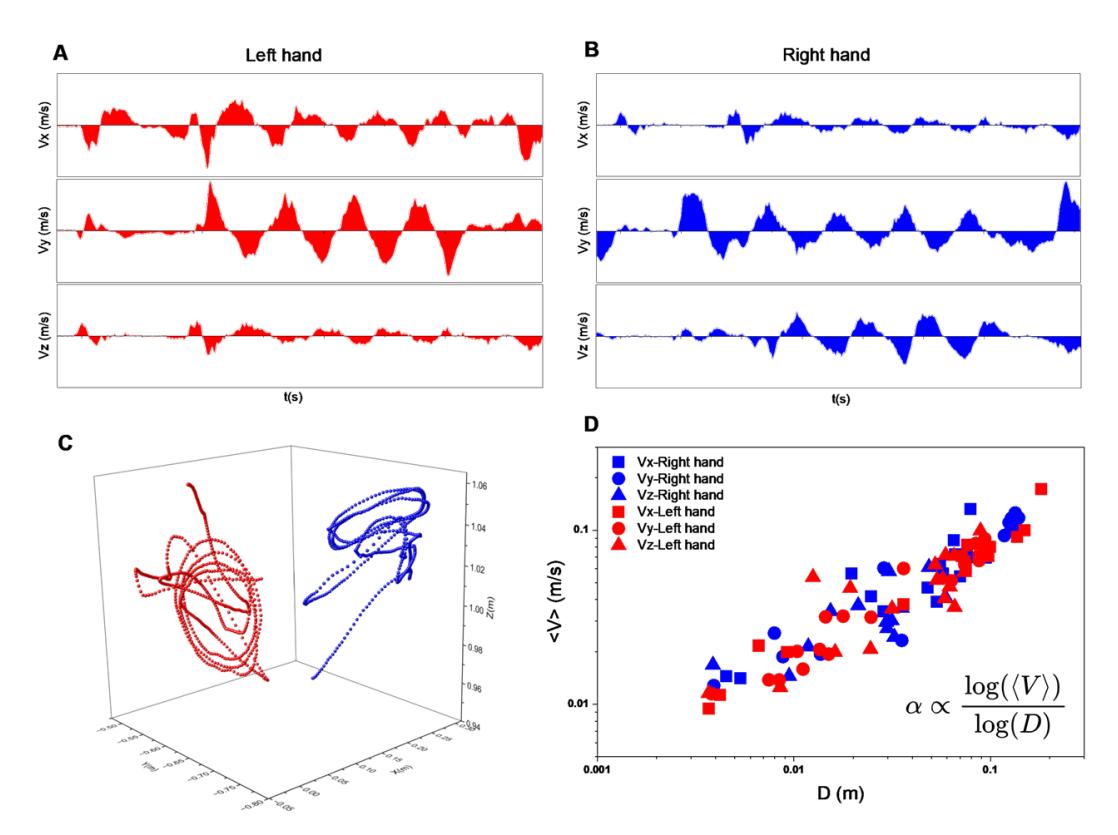
Collective improvisation in dance provides a rich natural laboratory for studying emergent coordination in coupled neuro-motor systems. Here, we investigate how training shapes spontaneous synchronization patterns in both movement dynamics and brain signals during collaborative performance. Using a dual-recording protocol integrating 3D motion capture and hyperscanning EEG, participants engaged in free, interaction-driven, and rule-based improvisation before and after a program of generative dance, grounded in cellular-automata. Motor behavior was modeled through a time-resolved α-exponent derived from Movement Element Decomposition scaling between mean velocity and displacement, revealing fluctuations in energetic strategies and degrees of freedom. Synchronization events were quantified using Motif Synchronization (biomechanical data) and multilayer Time-Varying Graphs (neural data), enabling the detection of nontrivial lead-lag dependencies beyond zero-lag entrainment. Results indicate that training produced an intriguing dissociation: interbrain synchronization increased, particularly within the frontal lobe, while interpersonal motor synchrony decreased. This opposite trend suggests that enhanced participatory sense-making fosters neural alignment while simultaneously expanding individual motor explorations, thereby reducing coupling in movement. Our findings position collaborative improvisation as a complex dynamical regime in which togetherness emerges not from identical motor outputs but from shared neural intentionality distributed across multilayer interaction networks, exemplifying the couplingdecoupling paradox, whereby increasing inter-brain synchrony supports the exploration of broader and mutually divergent motor trajectories. These results highlight the nonlinear nature of social coordination, offering new avenues for modeling creative joint action in human systems.
§ The Valyu brief
Reading the full paper and taking notes. This takes a few seconds…
§ Ask this paper
Ask a question about this paper
Valyu reads the full text and answers from what the paper actually says.
Searching the other archives…