Use and usability: concepts of representation in philosophy, neuroscience, cognitive science, and computer science
Ben Baker, Richard D. Lange, Andrew Richmond, Nikolaus Kriegeskorte, Rosa Cao, Xaq Pitkow, Odelia Schwartz
Abstract
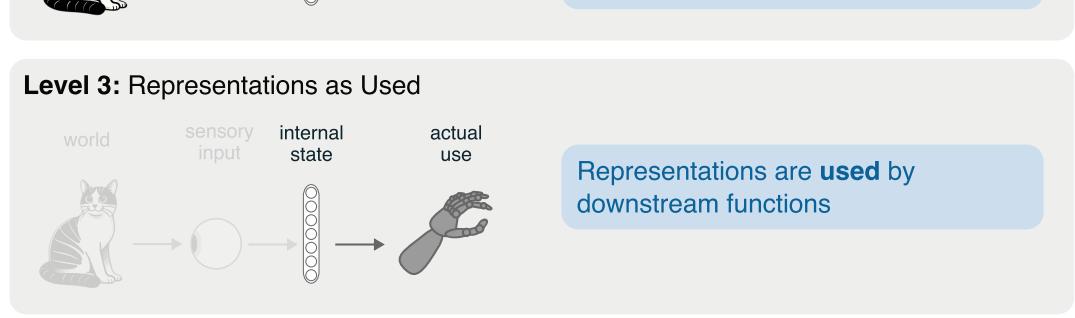
Representations play a central role in the study of both biological and artificial intelligence, as well as philosophy of mind. Across neuroscience, computer science, and philosophy, a recurring theme is that representations not only carry information but should be ``useful'' for or ``usable'' by an agent in some sense. Here, we review how the ``usefulness'' of representations has been conceptualized and how it figures into different conceptions of representation. We identify and explore four aspects of use and usability: representations generally carry \textit{information}; that information may or may not be \textit{useful} and it may or may not be encoded in a usable \textit{format}; and the representations may or may not be \textit{used downstream}. Building on these four aspects of information and use, we then organize existing perspectives on neural representations into three levels: Representations as Information (Level 1); Representations as Usable (Level 2); and Representations as Used (Level 3). Our account is meant to give readers an appreciation for the diversity of notions of ``neural representation,'' help them navigate the vast and multi-disciplinary literature on the topic, and help them clarify the appropriate notion of representation for their own investigations.
§ The Valyu brief
Reading the full paper and taking notes. This takes a few seconds…
§ Ask this paper
Ask a question about this paper
Valyu reads the full text and answers from what the paper actually says.
Searching the other archives…