Quantum error correction and biological error correction: A structural analogy between qubits and neurons
Ian Whitehouse, Anıl Zenginoğlu, Franz Klein, Mohe Edeen Abu Maizer, Wilson Smith, Skylar Chan, Siri Duddella, Wolfgang Losert
Abstract
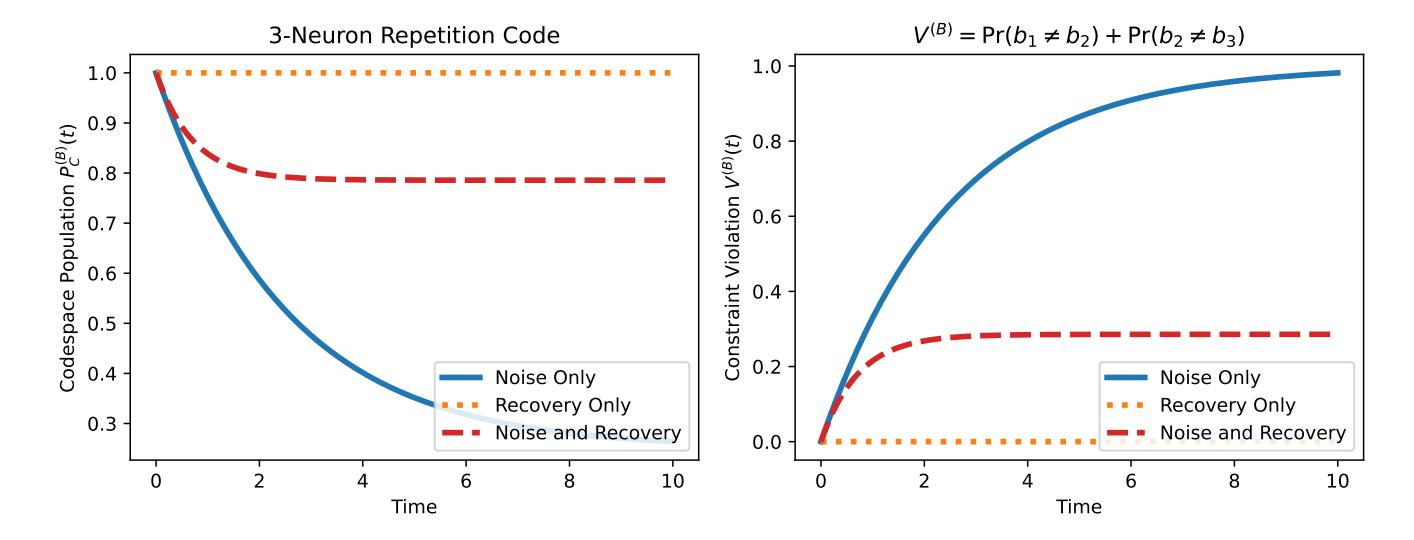
We draw a structural analogy between quantum error correction (QEC) and error handling in neural circuits with respect to their redundant encodings and constraint-based inferences. In QEC, logical information is embedded in a protected codespace within a larger Hilbert space. A set of commuting checks (e.g. stabilizer constraints) is repeatedly evaluated to produce an error syndrome that identifies which constraints were violated without directly revealing the logical state. A decoder then maps the syndrome to a recovery operation that returns the system to the codespace and suppresses logical failure below a threshold. Neural circuits exhibit error-control strategies that can be viewed through a related biological error correction (BEC) pattern: information is distributed across multiple neurons (redundant encoding), yielding reliable collective activity from error-prone unit operations of individual neurons. The structural analogy with QEC raises the question whether collective activity may be constrained on lower-dimensional manifolds (a biological codespace), allowing recurrent circuit dynamics and mismatch signals to function as syndrome-like indicators of constraint violations, driving fast corrective dynamics and slower adaptive updates. Our structural analogy also suggests that new insights into brain-inspired algorithms for collective information processing may inform novel QEC approaches. We perform numerical experiments using simplified models of qubit and neuron dynamics to illustrate the analogy.
§ The Valyu brief
Reading the full paper and taking notes. This takes a few seconds…
§ Ask this paper
Ask a question about this paper
Valyu reads the full text and answers from what the paper actually says.
Searching the other archives…