Transient Phase Clusters in a Two-Population Network of Kuramoto Oscillators with Heterogeneous Adaptive Interaction
Dmitry V. Kasatkin, Vladimir I. Nekorkin, José F. F. Mendes
Abstract
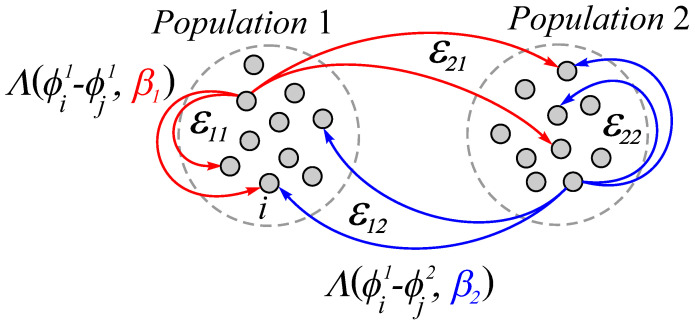
Adaptive interactions are an important property of many real-word network systems. A feature of such networks is the change in their connectivity depending on the current states of the interacting elements. In this work, we study the question of how the heterogeneous character of adaptive couplings influences the emergence of new scenarios in the collective behavior of networks. Within the framework of a two-population network of coupled phase oscillators, we analyze the role of various factors of heterogeneous interaction, such as the rules of coupling adaptation and the rate of their change in the formation of various types of coherent behavior of the network. We show that various schemes of heterogeneous adaptation lead to the formation of transient phase clusters of various types.
§ The Valyu brief
Reading the full paper and taking notes. This takes a few seconds…
§ Ask this paper
Ask a question about this paper
Valyu reads the full text and answers from what the paper actually says.
Searching the other archives…