Conversational Agents in Health Care: Expert Interviews to Inform the Definition, Classification, and Conceptual Framework
Gunther Eysenbach, Tiffany Leung, Xr B, Pei-Hung Liao, Laura Martinengo, Xiaowen Lin, Ahmad Ishqi Jabir, Tobias Kowatsch, Rifat Atun, Josip Car, Lorainne Tudor Car
Abstract
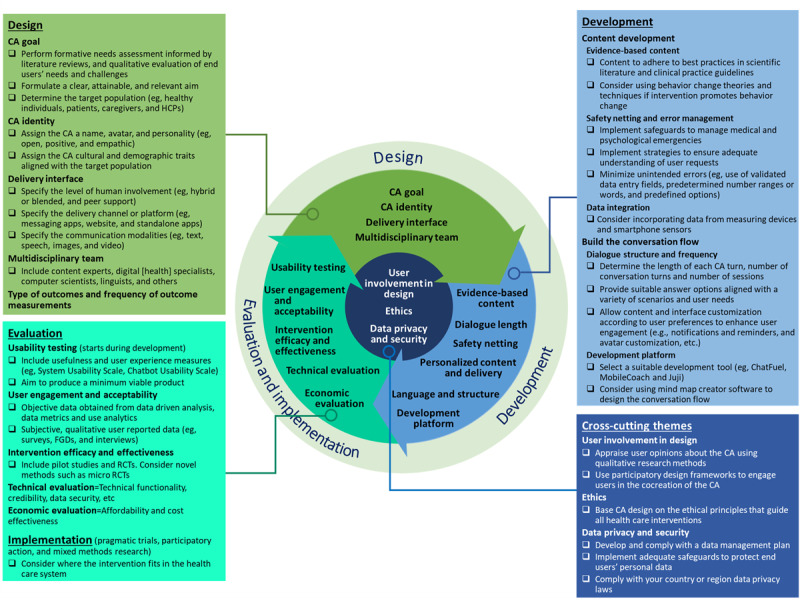
Background Conversational agents (CAs), or chatbots, are computer programs that simulate conversations with humans. The use of CAs in health care settings is recent and rapidly increasing, which often translates to poor reporting of the CA development and evaluation processes and unreliable research findings. We developed and published a conceptual framework, designing, developing, evaluating, and implementing a smartphone-delivered, rule-based conversational agent (DISCOVER), consisting of 3 iterative stages of CA design, development, and evaluation and implementation, complemented by 2 cross-cutting themes (user-centered design and data privacy and security). Objective This study aims to perform in-depth, semistructured interviews with multidisciplinary experts in health care CAs to share their views on the definition and classification of health care CAs and evaluate and validate the DISCOVER conceptual framework. Methods We conducted one-on-one semistructured interviews via Zoom (Zoom Video Communications) with 12 multidisciplinary CA experts using an interview guide based on our framework. The interviews were audio recorded, transcribed by the research team, and analyzed using thematic analysis. Results Following participants’ input, we defined CAs as digital interfaces that use natural language to engage in a synchronous dialogue using ≥1 communication modality, such as text, voice, images, or video. CAs were classified by 13 categories: response generation method, input and output modalities, CA purpose, deployment platform, CA development modality, appearance, length of interaction, type of CA-user interaction, dialogue initiation, communication style, CA personality, human support, and type of health care intervention. Experts considered that the conceptual framework could be adapted for artificial intelligence-based CAs. However, despite recent advances in artificial intelligence, including large language models, the technology is not able to ensure safety and reliability in health care settings.
§ The Valyu brief
Reading the full paper and taking notes. This takes a few seconds…
§ Ask this paper
Ask a question about this paper
Valyu reads the full text and answers from what the paper actually says.
Searching the other archives…