Ramping dynamics and theta oscillations reflect dissociable signatures during rule-guided human behavior
Jan Weber, Anne-Kristin Solbakk, Alejandro O. Blenkmann, Anais Llorens, Ingrid Funderud, Sabine Leske, Pål Gunnar Larsson, Jugoslav Ivanovic, Robert T. Knight, Tor Endestad, Randolph F. Helfrich
Abstract
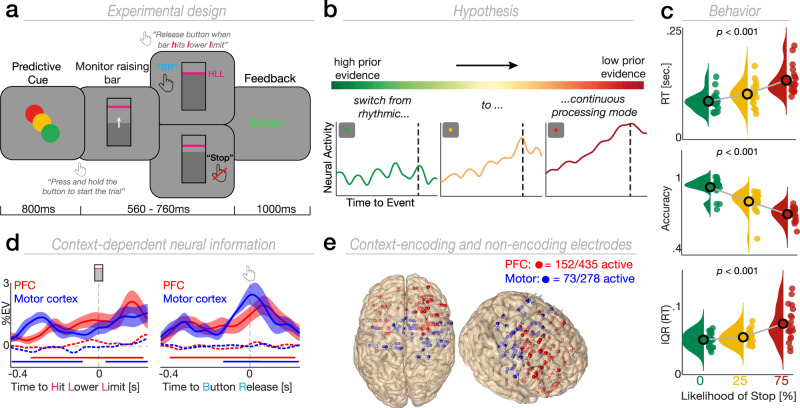
'Anais Llorens' 'Ingrid Funderud' 'Sabine Leske' 'Pål Gunnar Larsson' 'Jugoslav Ivanovic' 'Robert T. Knight' 'Tor Endestad' 'Randolph F. Helfrich'] Contextual cues and prior evidence guide human goal-directed behavior. The neurophysiological mechanisms that implement contextual priors to guide subsequent actions in the human brain remain unclear. Using intracranial electroencephalography (iEEG), we demonstrate that increasing uncertainty introduces a shift from a purely oscillatory to a mixed processing regime with an additional ramping component. Oscillatory and ramping dynamics reflect dissociable signatures, which likely differentially contribute to the encoding and transfer of different cognitive variables in a cue-guided motor task. The results support the idea that prefrontal activity encodes rules and ensuing actions in distinct coding subspaces, while theta oscillations synchronize the prefrontal-motor network, possibly to guide action execution. Collectively, our results reveal how two key features of large-scale neural population activity, namely continuous ramping dynamics and oscillatory synchrony, jointly support rule-guided human behavior.
§ The Valyu brief
Reading the full paper and taking notes. This takes a few seconds…
§ Ask this paper
Ask a question about this paper
Valyu reads the full text and answers from what the paper actually says.
Searching the other archives…