Generating synthetic population for simulating the spatiotemporal dynamics of epidemics Synthetic population for epidemic dynamics
Kemin Zhu, Ling Yin, Kang Liu, Junli Liu, Yepeng Shi, Xuan Li, Hongyang Zou, Huibin Du, Benjamin Althouse
Abstract
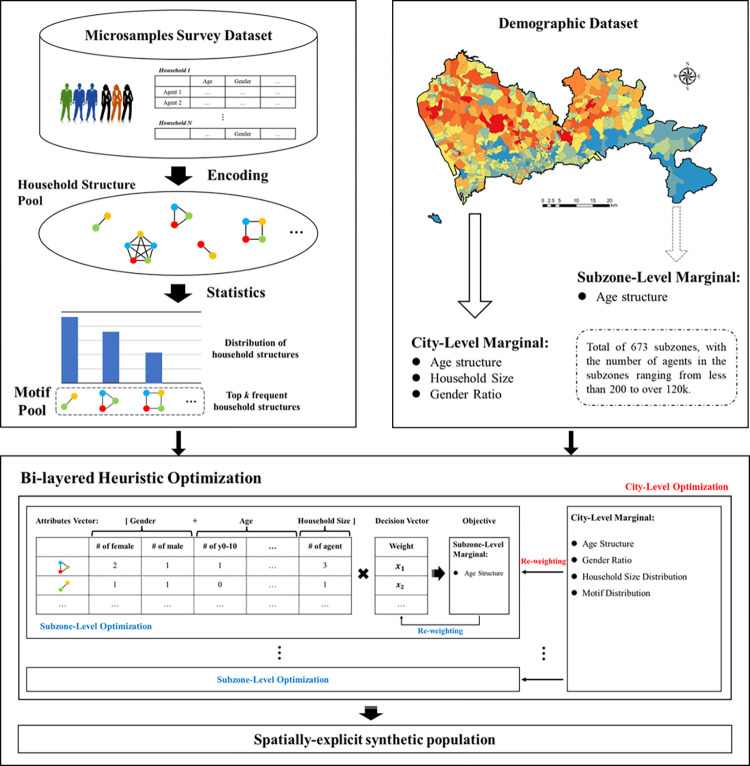
'Hongyang Zou' 'Huibin Du' 'Benjamin Althouse'] Agent-based models have gained traction in exploring the intricate processes governing the spread of infectious diseases, particularly due to their proficiency in capturing nonlinear interaction dynamics. The fidelity of agent-based models in replicating real-world epidemic scenarios hinges on the accurate portrayal of both population-wide and individual-level interactions. In situations where comprehensive population data are lacking, synthetic populations serve as a vital input to agent-based models, approximating real-world demographic structures. While some current population synthesizers consider the structural relationships among agents from the same household, there remains room for refinement in this domain, which could potentially introduce biases in subsequent disease transmission simulations. In response, this study unveils a novel methodology for generating synthetic populations tailored for infectious disease transmission simulations. By integrating insights from microsample-derived household structures, we employ a heuristic combinatorial optimizer to recalibrate these structures, subsequently yielding synthetic populations that faithfully represent agent structural relationships. Implementing this technique, we successfully generated a spatially-explicit synthetic population encompassing over 17 million agents for Shenzhen, China. The findings affirm the method’s efficacy in delineating the inherent statistical structural relationship patterns, aligning well with demographic benchmarks at both city and subzone tiers. Moreover, when assessed against a stochastic agent-based Susceptible-Exposed-Infectious-Recovered model, our results pinpointed that variations in population synthesizers can notably alter epidemic projections, influencing both the peak incidence rate and its onset.
§ The Valyu brief
Reading the full paper and taking notes. This takes a few seconds…
§ Ask this paper
Ask a question about this paper
Valyu reads the full text and answers from what the paper actually says.
Searching the other archives…