Finding potential lncRNA–disease associations using a boosting-based ensemble learning model Zhou et al. 10.3389/fgene.2024.1356205
Liqian Zhou, Xinhuai Peng, Lijun Zeng, Lihong Peng
Abstract
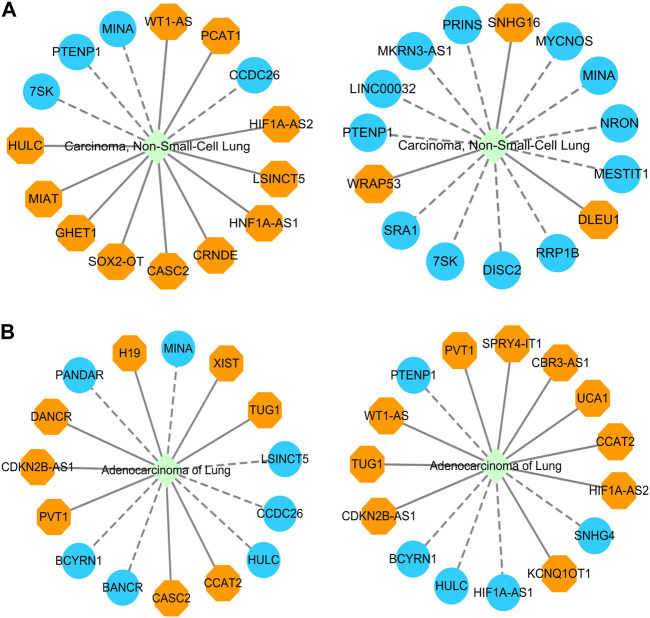
Introduction: Long non-coding RNAs (lncRNAs) have been in the clinical use as potential prognostic biomarkers of various types of cancer. Identifying associations between lncRNAs and diseases helps capture the potential biomarkers and design efficient therapeutic options for diseases. Wet experiments for identifying these associations are costly and laborious. Methods: We developed LDA-SABC, a novel boosting-based framework for lncRNA-disease association (LDA) prediction. LDA-SABC extracts LDA features based on singular value decomposition (SVD) and classifies lncRNA-disease pairs (LDPs) by incorporating LightGBM and AdaBoost into the convolutional neural network. Results: The LDA-SABC performance was evaluated under five-fold cross validations (CVs) on lncRNAs, diseases, and LDPs. It obviously outperformed four other classical LDA inference methods (SDLDA, LDNFSGB, LDASR, and IPCAF) through precision, recall, accuracy, F1 score, AUC, and AUPR. Based on the accurate LDA prediction performance of LDA-SABC, we used it to find potential lncRNA biomarkers for lung cancer. The results elucidated that 7SK and HULC could have a relationship with non-small-cell lung cancer (NSCLC) and lung adenocarcinoma (LUAD), respectively. Conclusion: We hope that our proposed LDA-SABC method can help improve the LDA identification.
§ The Valyu brief
Reading the full paper and taking notes. This takes a few seconds…
§ Ask this paper
Ask a question about this paper
Valyu reads the full text and answers from what the paper actually says.
Searching the other archives…