Metabolic syndrome predictive modelling in Bangladesh applying machine learning approach Metabolic Syndrome prediction in Bangladesh using machine learning
Md Farhad Hossain, Shaheed Hossain, Mst. Nira Akter, Ainur Nahar, Bowen Liu, Md Omar Faruque, Aleksandra Klisic
Abstract
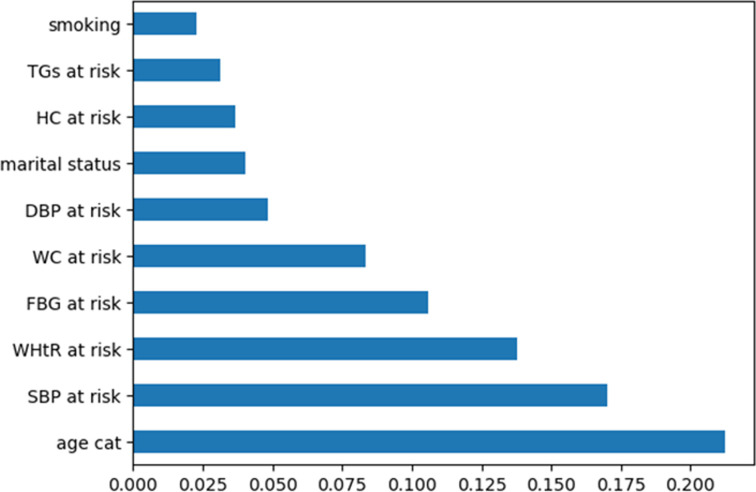
'Bowen Liu' 'Md Omar Faruque' 'Aleksandra Klisic'] Metabolic syndrome (MetS) is a cluster of interconnected metabolic risk factors, including abdominal obesity, high blood pressure, and elevated fasting blood glucose levels, that result in an increased risk of heart disease and stroke. In this research, we aim to identify the risk factors that have an impact on MetS in the Bangladeshi population. Subsequently, we intend to construct predictive machine learning (ML) models and ultimately, assess the accuracy and reliability of these models. In this particular study, we utilized the ATP III criteria as the basis for evaluating various health parameters from a dataset comprising 8185 participants in Bangladesh. After employing multiple ML algorithms, we identified that 27.8% of the population exhibited a prevalence of MetS. The prevalence of MetS was higher among females, accounting for 58.3% of the cases, compared to males with a prevalence of 41.7%. Initially, we identified the crucial variables using Chi-Square and Random Forest techniques. Subsequently, the obtained optimal variables are employed to train various models including Decision Trees, Random Forests, Support Vector Machines, Extreme Gradient Boosting, K-nearest neighbors, and Logistic Regression. Particularly we employed the ATP III criteria, which utilizes the Waist-to-Height Ratio (WHtR) as an anthropometric index for diagnosing abdominal obesity. Our analysis indicated that Age, SBP, WHtR, FBG, WC, DBP, marital status, HC, TGs, and smoking emerged as the most significant factors when using Chi-Square and Random Forest analyses. However, further investigation is necessary to evaluate its precision as a classification tool and to improve the accuracy of all classifiers for MetS prediction.
§ The Valyu brief
Reading the full paper and taking notes. This takes a few seconds…
§ Ask this paper
Ask a question about this paper
Valyu reads the full text and answers from what the paper actually says.
Searching the other archives…