The Effect of Elevation Gradient on Distribution and Body Size of Carabid Beetles in the Changbaishan Nature Reserve in Northeast Asia
Shengdong Liu, Jiaqi Tong, Mingfeng Xu, Qingfan Meng, Ying Shi, Hongrui Zhao, Yan Li, Bruno Rossaro
Abstract
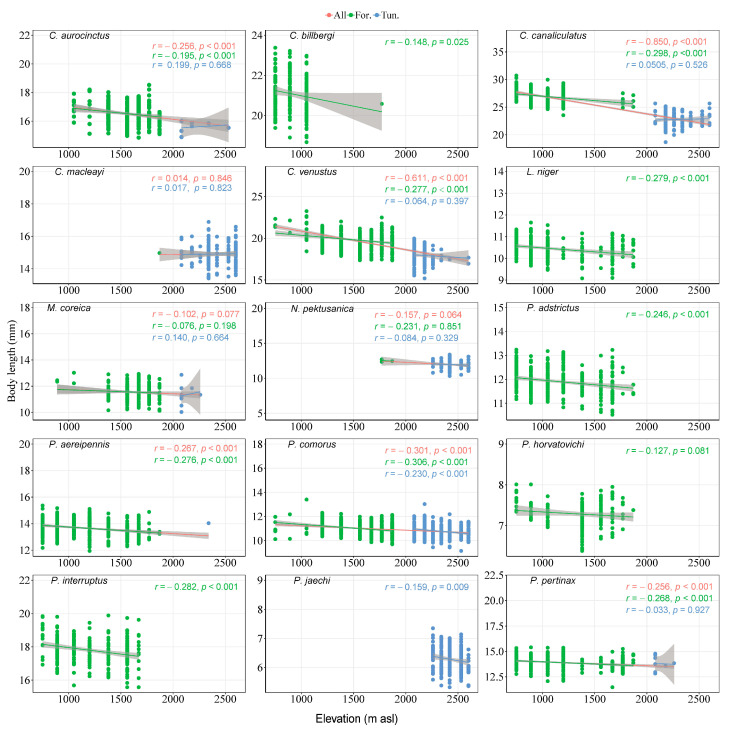
Simple Summary This study is a first attempt to address the critical issue of effect of elevation on the distribution and body size of carabid beetles in the same region, including mountainous forests and the alpine tundra of the upper limit of vegetation in the north cold temperate zone. The richness, abundance and body size of carabid beetles linearly decrease with elevation increase. The larger carabid species C. canaliculatus and C. venustus become smaller to adapt to high-elevation tundra conditions. The vegetation type changes at high elevations is an important factor that leads to changes of carabid distribution and body size along the elevation gradient. These high-elevation species such as C. macleayi, N. pektusanica and P. jaechi should be given priority attention in the context of global climate change. Abstract The environment of mountain ecosystems can change greatly in short distances as elevation increases. The effects of elevation change on the distribution and body size of carabid beetles were investigated at elevations of 750-2600 m in the Changbaishan Nature Reserve (Northeast China). The richness and abundance of carabid species decreased significantly as elevation increased. However, the change trends are different in forests and tundra. In the broad-leaved Korean pine forest and coniferous forest at low elevations, carabid beetle species have high richness and abundance. The community composition of carabid beetles was significantly different at different elevations and among different vegetation types. Some species only occurred at specific elevations. There were fewer indicator species in high-elevation areas, but Carabus macleayi Dejean, Nebria pektusanica Horratovich and Pterostichus jaechi Kirschenhofer were mainly found in high-elevation areas. The average body size of species in the carabid beetle community was negatively correlated with elevation. The sizes of the larger Carabus canaliculatus Adams and Carabus venustus Morawitz were negatively correlated with elevation. Their body sizes decreased obviously in the tundra at elevations above 2000 m.
§ The Valyu brief
Reading the full paper and taking notes. This takes a few seconds…
§ Ask this paper
Ask a question about this paper
Valyu reads the full text and answers from what the paper actually says.
Searching the other archives…