Capturing spontaneous interactivity: a multi-measure approach to analyzing the dynamics of interpersonal coordination in dance improvisation
Paige M. Whitehead, Hanne De Jaegher, Ivani Santana, Rebecca M. Todd, Stefanie Blain-Moraes
Abstract
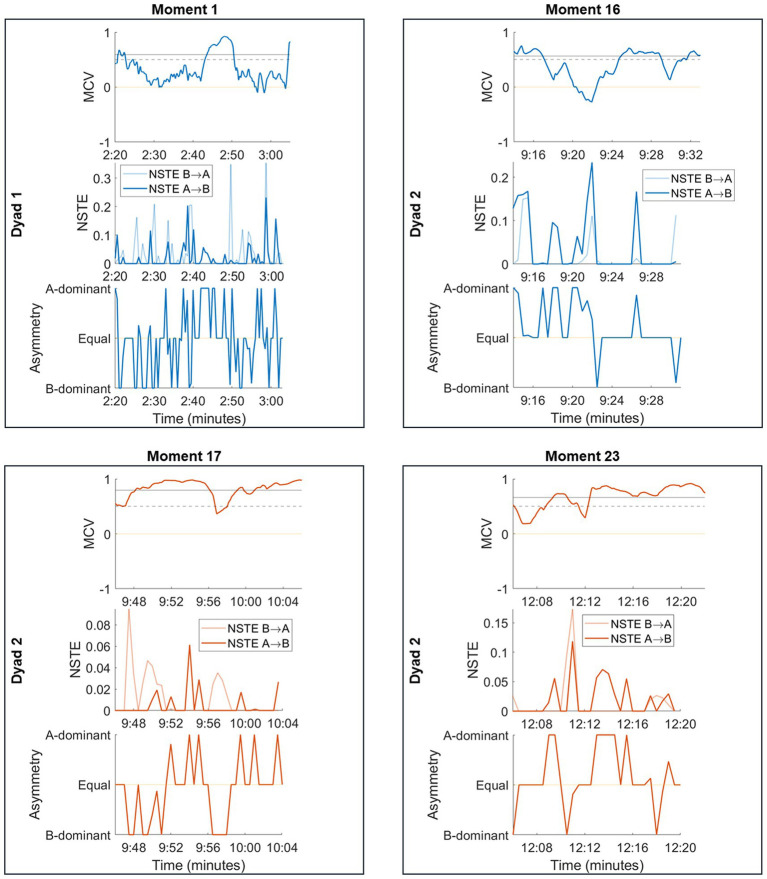
Introduction Interpersonal coordination is widely acknowledged as critical to relating with, connecting to, and understanding others, but the underlying mechanisms of this phenomenon are poorly understood. Dance-particularly improvised dance-offers a valuable paradigm for investigating the dynamics of interpersonal coordination due to its inherent ability to connect us. However, conventional approaches to studying coordination often fail to capture the co-creative spontaneity that is intrinsic to such interactions. Methods This study combined multiple measures of interpersonal coordination to detect moments of high coordination between two freely improvising dancers. We applied maximum correlation vectors, normalized Symbolic Transfer Entropy (NSTE), and surveys to analyze the time-varying dynamics of similarity in movement speeds, directed influence, and subjective perception of dancers engaged in an improvisation task. Results This multi-measure approach offers a means of capturing the interplay between different dimensions of interpersonal coordination. Discussion This approach may be used to understand the underlying mechanisms of co-creative social interactions in improvised dance and other forms of spontaneous interactivity.
§ The Valyu brief
Reading the full paper and taking notes. This takes a few seconds…
§ Ask this paper
Ask a question about this paper
Valyu reads the full text and answers from what the paper actually says.
Searching the other archives…