Statistical Testing of Random Number Generators and Their Improvement Using Randomness Extraction
Cameron Foreman, Richie Yeung, Florian J. Curchod, Andrei Khrennikov, Karl Svozil
Abstract
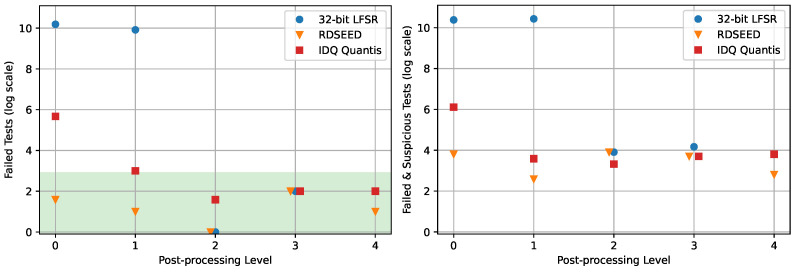
'Karl Svozil'] Random number generators (RNGs) are notoriously challenging to build and test, especially for cryptographic applications. While statistical tests cannot definitively guarantee an RNG’s output quality, they are a powerful verification tool and the only universally applicable testing method. In this work, we design, implement, and present various post-processing methods, using randomness extractors, to improve the RNG output quality and compare them through statistical testing. We begin by performing intensive tests on three RNGs-the 32-bit linear feedback shift register (LFSR), Intel’s ‘RDSEED,’ and IDQuantique’s ‘Quantis’-and compare their performance. Next, we apply the different post-processing methods to each RNG and conduct further intensive testing on the processed output. To facilitate this, we introduce a comprehensive statistical testing environment, based on existing test suites, that can be parametrised for lightweight (fast) to intensive testing.
§ The Valyu brief
Reading the full paper and taking notes. This takes a few seconds…
§ Ask this paper
Ask a question about this paper
Valyu reads the full text and answers from what the paper actually says.
Searching the other archives…