Tracing the inner edge of the habitable zone with sulfur chemistry Tracing the inner edge of the habitable zone with sulfur chemistry
Sean Jordan, Oliver Shorttle, Paul B. Rimmer
Abstract
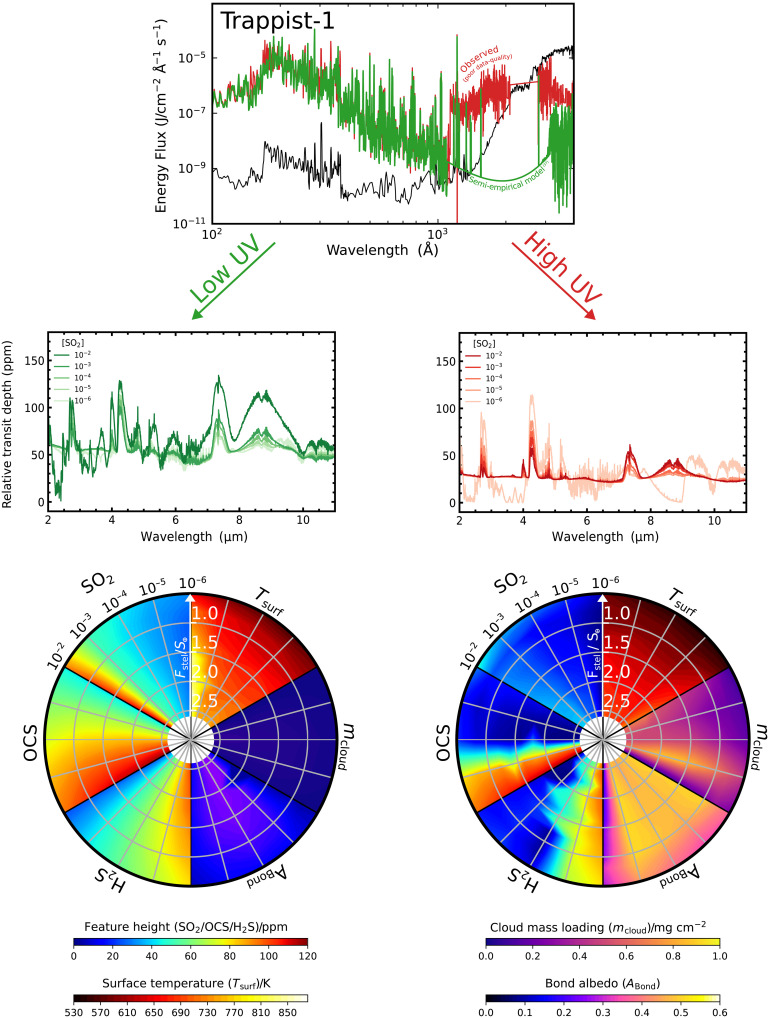
The circumstellar liquid-water habitable zone guides our search for potentially inhabited exoplanets but remains observationally untested. We show that the inner edge of the habitable zone can now be mapped among exoplanets using their lack of surface water, which, unlike the presence of water, can be unambiguously revealed by atmospheric sulfur species. Using coupled climate-chemistry modeling, we find that the observability of sulfur gases on exoplanets depends critically on the ultraviolet (UV) flux of their host star, a property with wide variation: Most M-dwarfs have a low UV flux and thereby allow the detection of sulfur gases as a tracer of dry planetary surfaces; however, the UV flux of Trappist-1 may be too high for sulfur to disambiguate uninhabitable from habitable surfaces on any of its planets. We generalize this result to show how a population-level search for sulfur chemistry on M-dwarf planets can be used to empirically define the habitable zone in the near future.
§ The Valyu brief
Reading the full paper and taking notes. This takes a few seconds…
§ Ask this paper
Ask a question about this paper
Valyu reads the full text and answers from what the paper actually says.
Searching the other archives…