A novel lossless encoding algorithm for data compression–genomics data as an exemplar Al-okaily and Tbakhi 10.3389/fbinf.2024.1489704
Anas Al-okaily, Abdelghani Tbakhi
Abstract
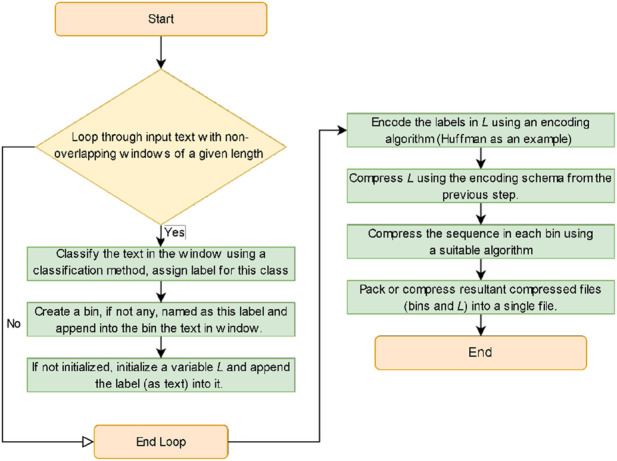
Data compression is a challenging and increasingly important problem. As the amount of data generated daily continues to increase, efficient transmission and storage have never been more critical. In this study, a novel encoding algorithm is proposed, motivated by the compression of DNA data and associated characteristics. The proposed algorithm follows a divide-and-conquer approach by scanning the whole genome, classifying subsequences based on similarities in their content, and binning similar subsequences together. The data is then compressed into each bin independently. This approach is different than the currently known approaches: entropy, dictionary, predictive, or transform-based methods. Proof-of-concept performance was evaluated using a benchmark dataset with seventeen genomes ranging in size from kilobytes to gigabytes. The results showed a considerable improvement in the compression of each genome, preserving several megabytes compared to state-of-the-art tools. Moreover, the algorithm can be applied to the compression of other data types include mainly text, numbers, images, audio, and video which are being generated daily and unprecedentedly in massive volumes.
§ The Valyu brief
Reading the full paper and taking notes. This takes a few seconds…
§ Ask this paper
Ask a question about this paper
Valyu reads the full text and answers from what the paper actually says.
Searching the other archives…