Compression-enabled interpretability of voxelwise encoding models Compression-enabled interpretability of voxelwise encoding models
Fatemeh Kamali, Amir Abolfazl Suratgar, Mohammadbagher Menhaj, Reza Abbasi-Asl, Daniele Marinazzo
Abstract
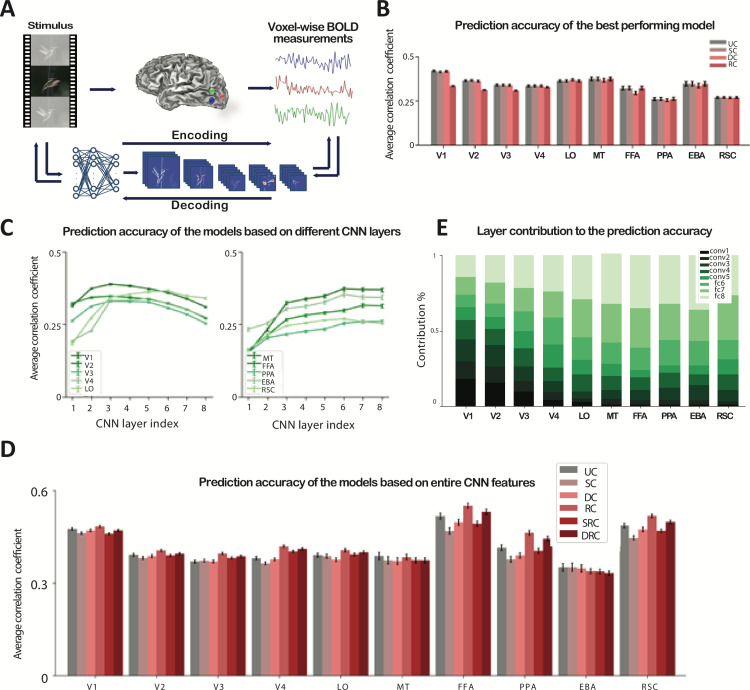
'Reza Abbasi-Asl' 'Daniele Marinazzo'] Voxelwise encoding models based on convolutional neural networks (CNNs) are widely used as predictive models of brain activity evoked by natural movies. Despite their superior predictive performance, the huge number of parameters in CNN-based models have made them difficult to interpret. Here, we investigate whether model compression can build more interpretable and more stable CNN-based voxelwise models while maintaining accuracy. We used multiple compression techniques to prune less important CNN filters and connections, a receptive field compression method to select receptive fields with optimal center and size, and principal component analysis to reduce dimensionality. We demonstrate that the model compression improves the accuracy of identifying visual stimuli in a hold-out test set. Additionally, compressed models offer a more stable interpretation of voxelwise pattern selectivity than uncompressed models. Finally, the receptive field-compressed models reveal that the optimal model-based population receptive fields become larger and more centralized along the ventral visual pathway. Overall, our findings support using model compression to build more interpretable voxelwise models.
§ The Valyu brief
Reading the full paper and taking notes. This takes a few seconds…
§ Ask this paper
Ask a question about this paper
Valyu reads the full text and answers from what the paper actually says.
Searching the other archives…