Imputation and Missing Indicators for Handling Missing Longitudinal Data: Data Simulation Analysis Based on Electronic Health Record Data
Molly Ehrig, Garrett S Bullock, Xiaoyan Iris Leng, Nicholas M Pajewski, Jaime Lynn Speiser, Christian Lovis
Abstract
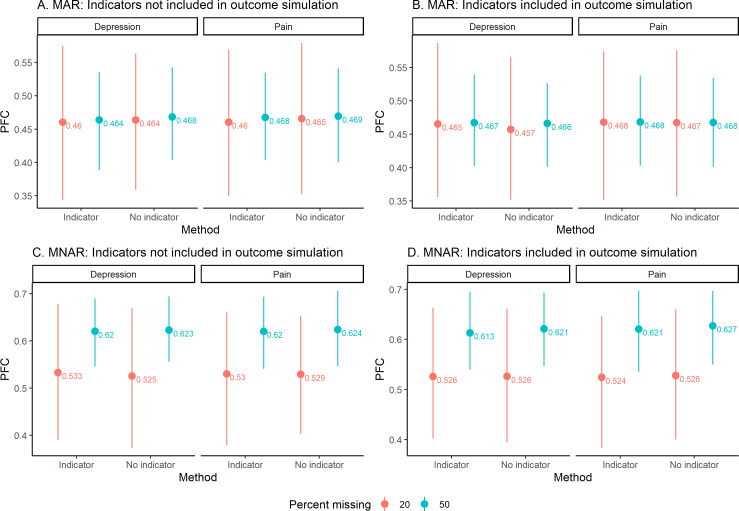
'Nicholas M Pajewski' 'Jaime Lynn Speiser' 'Christian Lovis'] Title: Abstract Background Missing data in electronic health records are highly prevalent and result in analytical concerns such as heterogeneous sources of bias and loss of statistical power. One simple analytic method for addressing missing or unknown covariate values is to treat missingness for a particular variable as a category onto itself, which we refer to as the missing indicator method. For cross-sectional analyses, recent work suggested that there was minimal benefit to the missing indicator method; however, it is unclear how this approach performs in the setting of longitudinal data, in which correlation among clustered repeated measures may be leveraged for potentially improved model performance. Objectives This study aims to conduct a simulation study to evaluate whether the missing indicator method improved model performance and imputation accuracy for longitudinal data mimicking an application of developing a clinical prediction model for falls in older adults based on electronic health record data. Methods We simulated a longitudinal binary outcome using mixed effects logistic regression that emulated a falls assessment at annual follow-up visits. Using multivariate imputation by chained equations, we simulated time-invariant predictors such as sex and medical history, as well as dynamic predictors such as physical function, BMI, and medication use. We induced missing data in predictors under scenarios that had both random (missing at random) and dependent missingness (missing not at random). We evaluated aggregate performance using the area under the receiver operating characteristic curve (AUROC) for models with and with no missing indicators as predictors, as well as complete case analysis, across simulation replicates. We evaluated imputation quality using normalized root-mean-square error for continuous variables and percent falsely classified for categorical variables.
§ The Valyu brief
Reading the full paper and taking notes. This takes a few seconds…
§ Ask this paper
Ask a question about this paper
Valyu reads the full text and answers from what the paper actually says.
Searching the other archives…