Neurocomputational Mechanisms of Sense of Agency: Literature Review for Integrating Predictive Coding and Adaptive Control in Human–Machine Interfaces
Anirban Dutta, Koichi Hiraoka
Abstract
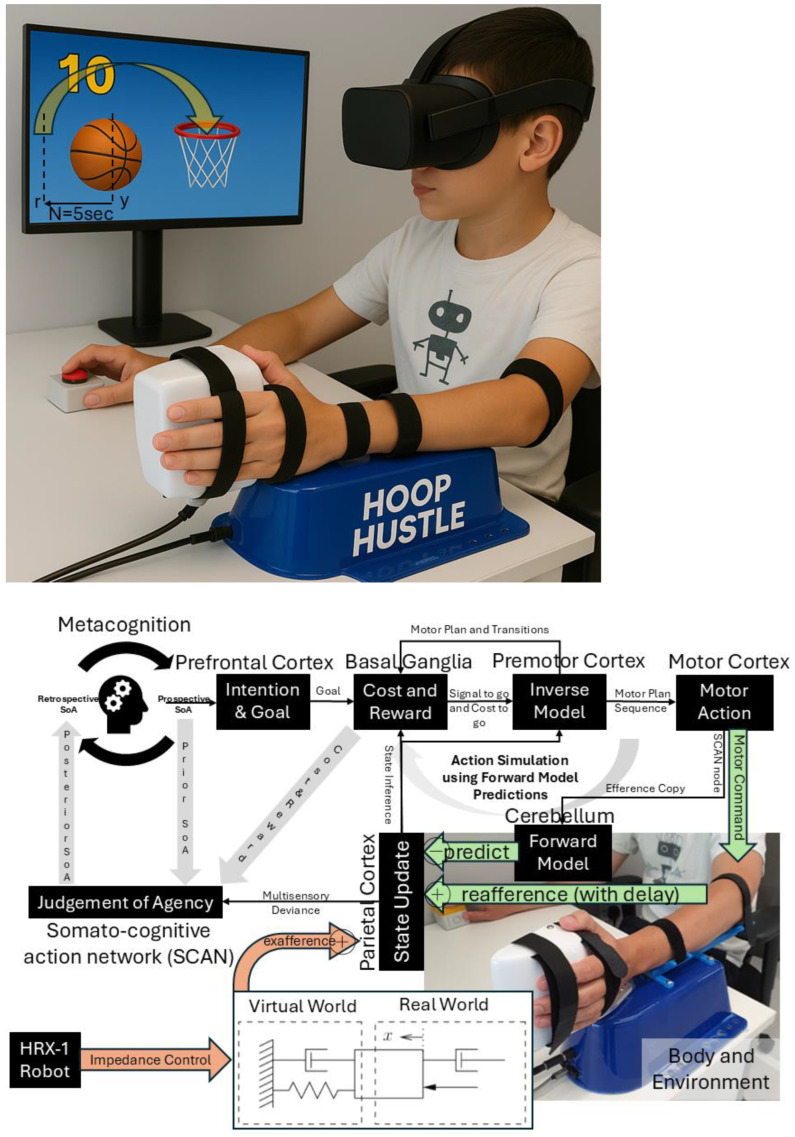
Background: The sense of agency (SoA)-the subjective experience of controlling one’s own actions and their consequences-is a fundamental aspect of human cognition, volition, and motor control. Understanding how the SoA arises and is disrupted in neuropsychiatric disorders has significant implications for human-machine interface (HMI) design for neurorehabilitation. Traditional cognitive models of agency often fail to capture its full complexity, especially in dynamic and uncertain environments. Objective: This review synthesizes computational models-particularly predictive coding, Bayesian inference, and optimal control theories-to provide a unified framework for understanding the SoA in both healthy and dysfunctional brains. It aims to demonstrate how these models can inform the design of adaptive HMIs and therapeutic tools by aligning with the brain’s own inference and control mechanisms. Methods: I reviewed the foundational and contemporary literature on predictive coding, Kalman filtering, the Linear-Quadratic-Gaussian (LQG) control framework, and active inference. I explored their integration with neurophysiological mechanisms, focusing on the somato-cognitive action network (SCAN) and its role in sensorimotor integration, intention encoding, and the judgment of agency. Case studies, simulations, and XR-based rehabilitation paradigms using robotic haptics were used to illustrate theoretical concepts. Results: The SoA emerges from hierarchical inference processes that combine top-down motor intentions with bottom-up sensory feedback. Predictive coding frameworks, especially when implemented via Kalman filters and LQG control, provide a mechanistic basis for modeling motor learning, error correction, and adaptive control. Disruptions in these inference processes underlie symptoms in disorders such as functional movement disorder. XR-based interventions using robotic interfaces can restore the SoA by modulating sensory precision and motor predictions through adaptive feedback and suggestion. Computer simulations demonstrate how internal models, and hypnotic suggestions influence state estimation, motor execution, and the recovery of agency.
§ The Valyu brief
Reading the full paper and taking notes. This takes a few seconds…
§ Ask this paper
Ask a question about this paper
Valyu reads the full text and answers from what the paper actually says.
Searching the other archives…