Streamlining cVEP Paradigms: Effects of a Minimized Electrode Montage on Brain–Computer Interface Performance
Milán András Fodor, Atilla Cantürk, Gernot Heisenberg, Ivan Volosyak, Iman Beheshti
Abstract
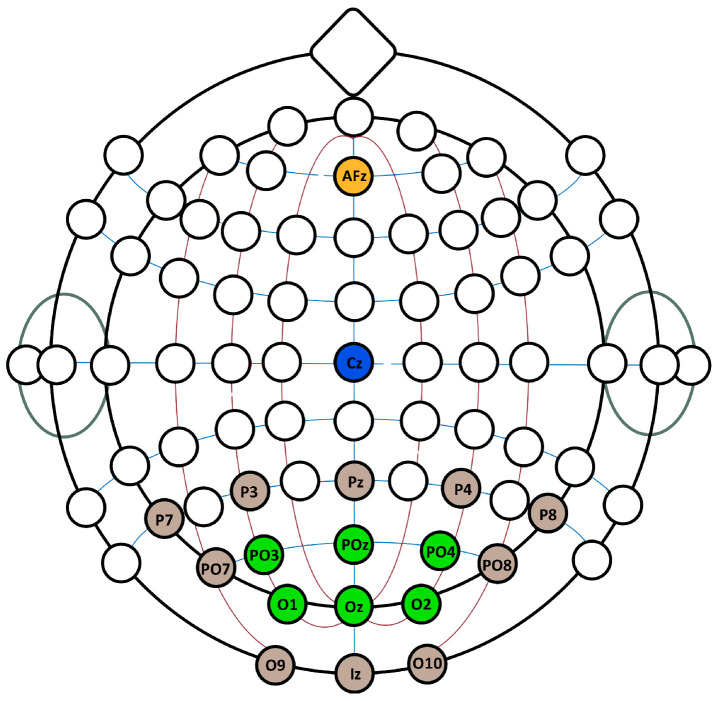
(1) Background: Brain-computer interfaces (BCIs) enable direct communication between the brain and external devices using electroencephalography (EEG) signals, offering potential applications in assistive technology and neurorehabilitation. Code-modulated visual evoked potential (cVEP)-based BCIs employ code-pattern-based stimulation to evoke neural responses, which can then be classified to infer user intent. While increasing the number of EEG electrodes across the visual cortex enhances classification accuracy, it simultaneously reduces user comfort and increases setup complexity, duration, and hardware costs. (2) Methods: This online BCI study, involving thirty-eight able-bodied participants, investigated how reducing the electrode count from 16 to 6 affected performance. Three experimental conditions were tested: a baseline 16-electrode configuration, a reduced 6-electrode setup without retraining, and a reduced 6-electrode setup with retraining. (3) Results: Our results indicate that, on average, performance declines with fewer electrodes; nonetheless, retraining restored near-baseline mean Information Transfer Rate (ITR) and accuracy for those participants for whom the system remained functional. The results reveal that for a substantial number of participants, the classification pipeline fails after electrode removal, highlighting individual differences in the cVEP response characteristics or inherent limitations of the classification approach. (4) Conclusions: Ultimately, this suggests that minimal cVEP-BCI electrode setups capable of reliably functioning across all users might only be feasible through other, more flexible classification methods that can account for individual differences. These findings aim to serve as a guideline for what is currently achievable with this common cVEP paradigm and to highlight where future research should focus in order to move closer to a practical and user-friendly system.
§ The Valyu brief
Reading the full paper and taking notes. This takes a few seconds…
§ Ask this paper
Ask a question about this paper
Valyu reads the full text and answers from what the paper actually says.
Searching the other archives…