Intracellular Mis-Localization of Modified RNA Molecules and Non-Coding RNAs: Facts from Hematologic Malignancies
Argiris Symeonidis, Argyri Chroni, Irene Dereki, Dionysios Chartoumpekis, Argyro Sgourou, Sherif T.S. Hassan
Abstract
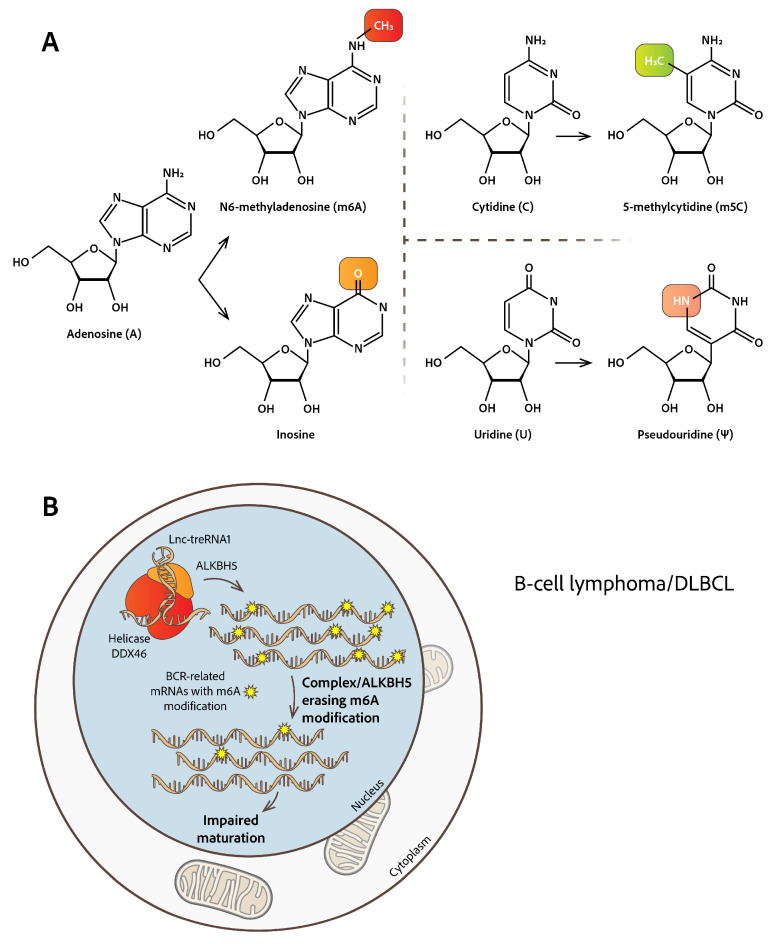
The intracellular topography of RNA molecules, encompassing ribonucleotides with biochemical modifications, such as N6-methyladenosine (m6A), 5-methylcytosine (m5C), adenosine to inosine (A → I) editing, and isomerization of uridine to pseudouridine (Ψ), as well as of non-coding RNA molecules, is currently studied within the frame of the epigenome. Circulating RNA molecules in the intracellular space that have incorporated information by carrying specific modifications depend on the balanced activity and correct subcellular installation of their modifying enzymes, the “writers”, “readers” and “erasers”. Modifications are critical for RNA translocation from the nucleus to the cytoplasm, for stability and translation efficiency, and for other, still-uncovered functions. Moreover, trafficking of non-coding RNA molecules depends on membrane transporters capable of recognizing signal sequences and RNA recognition-binding proteins that can facilitate their transport to different intracellular locations, guiding the establishment of interconnection possibilities with different macromolecular networks. The potential of long non-coding RNAs to form multilayer molecular connections, as well as the differential topology of micro-RNAs in cell nuclei, compared to cytoplasm, has been recognized by several studies. The study of the intercellular compartmentalization of these molecules has recently become feasible thanks to technological progress; however, a wealth of information has not yet been produced that would lead to safe conclusions regarding non-coding RNA’s contributions to the early steps of pathogenesis and disease progression in hematological malignancies. Both, the bone marrow, as the main hematopoietic tissue, and the lymphoid tissues are composed of cells with highly reactive potential to signals affecting the epigenome and initiating cascade pathways in response.
§ The Valyu brief
Reading the full paper and taking notes. This takes a few seconds…
§ Ask this paper
Ask a question about this paper
Valyu reads the full text and answers from what the paper actually says.
Searching the other archives…