Denoising spatially resolved transcriptomics with consistency of heterogeneous spatial coordinates, transcription, and morphology
Haiyue Wang, Peng Gao, Shaoqing Feng, Xiaoke Ma
Abstract
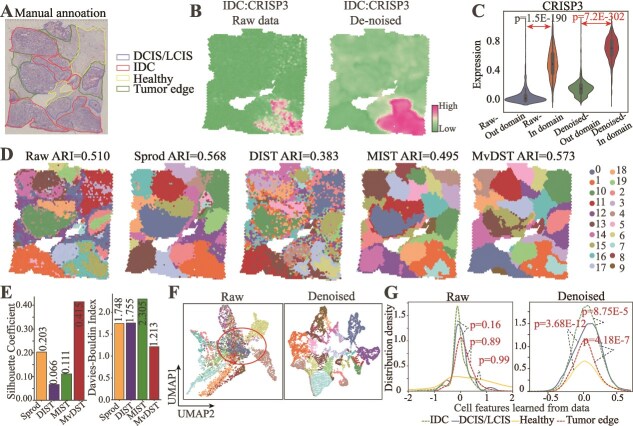
Spatially resolved transcriptomics (SRT) simultaneously captures spatial coordinates, pathological features, and transcriptional profiles of cells within intact tissues, offering unprecedented opportunities to explore tissue architecture. However, SRT data often suffer from substantial technical noise introduced by experimental procedures, posing challenges for downstream analyses. To overcome these challenges, we introduce a Multiview Denoising framework for Spatial Transcriptomics (MvDST), which integrates a deep autoencoder and self-supervised learning to jointly reconstruct expression profiles, denoise features, and enforce cross-view consistency, effectively reducing technical noise, and heterogeneity. As a result, MvDST reliably and accurately delineates tissue subgroups across simulated datasets under various perturbations. In real cancer datasets, it distinguishes tumor-associated domains, identifies region-specific marker genes, and reveals intra-tumoral heterogeneity. Furthermore, we validate the robustness of MvDST across multiple spatial transcriptomics platforms, including 10 \documentclass[12pt]{minimal} \usepackage{amsmath} \usepackage{wasysym} \usepackage{amsfonts} \usepackage{amssymb} \usepackage{amsbsy} \usepackage{upgreek} \usepackage{mathrsfs} \setlength{\oddsidemargin}{-69pt} \begin{document} $\times $\end{document} Visium, STARmap, and osmFISH. Overall, these results demonstrate that MvDST can serve as a crucial initial step for the analysis of spatially resolved transcriptomics data.
§ The Valyu brief
Reading the full paper and taking notes. This takes a few seconds…
§ Ask this paper
Ask a question about this paper
Valyu reads the full text and answers from what the paper actually says.
Searching the other archives…