Task Offloading Algorithm for Multiple Unmanned Aerial Vehicles Based on Temporal Graph
Lingyu Zhao, Xiaorong Zhu, Jianhong Cai, Jingjing Wang
Abstract
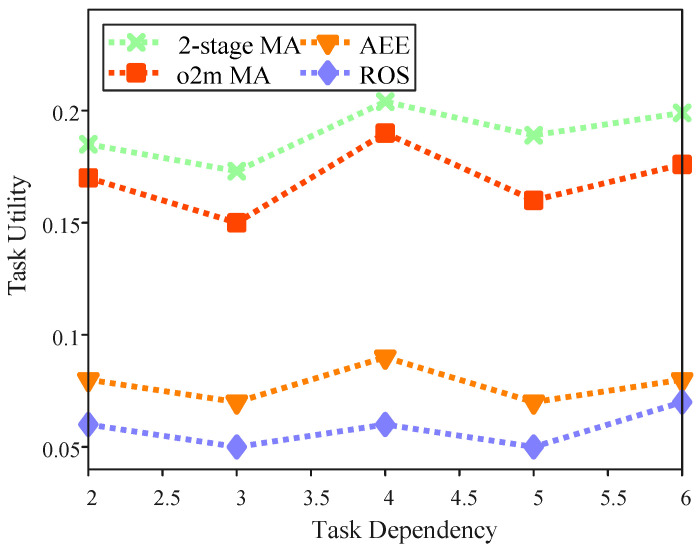
With the rapid expansion of data scale, compute-intensive tasks will become a core application of 6G networks. As Unmanned Aerial Vehicle (UAV) technology advances, UAVs can assist in task offloading for mobile edge computing by collaborating to overcome individual UAV limitations in battery life and computational capacity. Hence, in this paper, we propose a task offloading algorithm for multiple UAVs based on a temporal graph. We first formulate an optimization problem to minimize the total completion time of UAV swarm task offloading by classifying tasks and determining task priorities and subtask dependencies. To solve this problem, we introduce a temporal graph to simulate service nodes and task sequences in computing networks. It can reveal task execution priorities by calculating proximity indices, which indicate the ratio of physical distance to the sum of task weights, and determining timestamp offsets. In the following, to reduce unnecessary waiting and computation resource allocation risks, we transform the optimization problem into a directed acyclic graph connectivity problem, which identifies the fastest temporal paths for each UAV, forming a dedicated service network. Finally, we propose a two-stage matching algorithm that achieves optimal matching based on service node locations, statuses, task types, and offloading demands. Simulation results demonstrate that the algorithm performs exceptionally well, reducing task completion times and significantly outperforming other algorithms in terms of task utility.
§ The Valyu brief
Reading the full paper and taking notes. This takes a few seconds…
§ Ask this paper
Ask a question about this paper
Valyu reads the full text and answers from what the paper actually says.
Searching the other archives…