Prediction models developed using artificial intelligence: similar predictive performances with highly varying predictions for individuals – an illustration in deep vein thrombosis
Maerziya Yusufujiang, Constanza L Andaur Navarro, Johanna AA Damen, Toshihiko Takada, Geert-Jan Geersing, Lotty Hooft, Ewoud Schuit, Karel GM Moons, Valentijn MT de Jong, Maarten van Smeden
Abstract
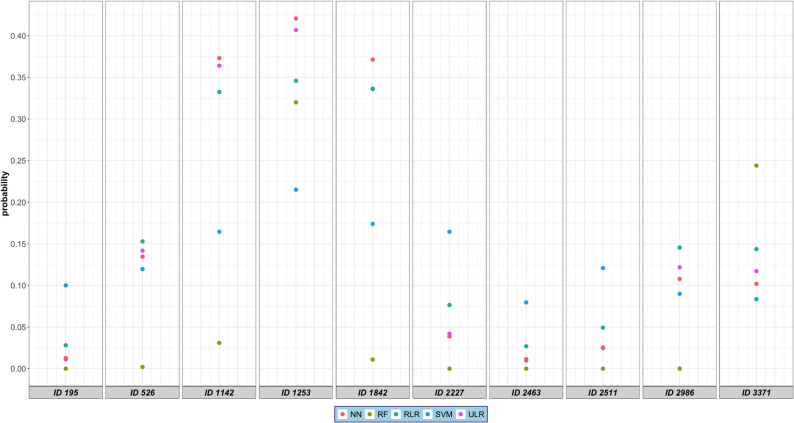
Objectives The rise in popularity and off-the-shelf availability of machine learning (ML) and AI-based methodology to develop new prediction models provides developers with ample choices to compare and select the best performing model out of many possible models. Many studies have shown that such comparisons on any particular dataset, the difference in performance between models developed using different techniques (e.g. logistic regression, vs. random forest or neural networks) can often be small, especially when looking at crude performance measures such as the area under the ROC curve. This may lead to the conclusion that such models are essentially exchangeable, and model selection is arbitrary. However, as we will illustrate using a dataset on deep venous thrombosis, prediction models with similar discriminative performance may nonetheless generate different outcome probability estimates for individual patients and potentially lead to meaningfully different decision making. Methods We developed diagnostic prediction models to predict the presence of deep venous thrombosis (DVT) in a large dataset of patients with leg symptoms suspected of having DVT, using five modelling techniques: unpenalized logistic regression (ULR), ridge logistic regression (RLR), random forests (RF), support vector machine (SVM) and neural network (NN). Age, sex, d-dimer, history of DVT, diagnosis alternative to DVT, and having cancer were used as a fixed set of predictors. Model performance was evaluated in terms of discrimination, calibration, and stability of individual risk prediction for a set of patients across the models. Results Of the 6,087 suspected patients, 1,146 (19%) were diagnosed with DVT based on leg ultrasound (reference test). Three prediction models (ULR, RLR, NN) had similar discrimination with AUCs point estimates of 0.84. However, the 6087 individuals’ estimated probabilities of DVT varied substantially across the five different modelling techniques, highlighting differences in prediction stability. Notably, the RF model tended to overestimate individual risks, while the SVM model tended to underestimate them compared to the other models.
§ The Valyu brief
Reading the full paper and taking notes. This takes a few seconds…
§ Ask this paper
Ask a question about this paper
Valyu reads the full text and answers from what the paper actually says.
Searching the other archives…