Fusing Multi-Temporal Context for Image Super-Resolution Reconstruction in Cultural Heritage Monitoring
Caiyan Chen, Fulong Chen, Sheng Gao, Hongqiang Li, Xinru Zhang, Yanni Cheng, Kaihua Zhang
Abstract
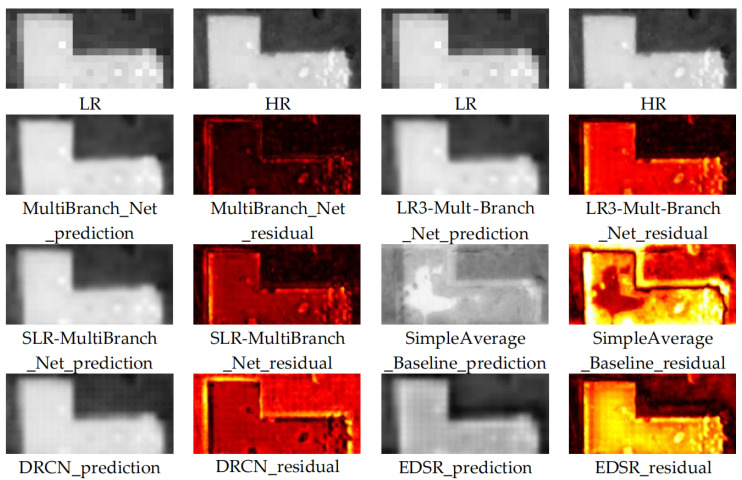
Highlights What are the main findings?1. A novel multi-branch, temporal change-aware super-resolution model is proposed, which explicitly leverages landscape evolution patterns from adjacent years to reconstruct high-quality imagery for a target year with missing data. 2. The proposed model significantly outperforms both single-image super-resolution baselines and a multi-temporal ablation model, achieving superior results on a real-world heritage dataset of the Weiyang Palace site. What are the implications of the main findings?1. This study transforms super-resolution from a simple image enhancement tool into a data-repair engine for dynamic monitoring, generating reconstructions that are consistent with the site’s temporal evolution logic. 2. The method provides a practical solution to the “temporal data gap” problem in heritage monitoring, establishing a reliable data foundation for high-precision tasks like change detection and long-term preservation planning. Abstract Effective conservation of World Heritage Sites relies on high-precision and continuous dynamic monitoring of their status. However, cloud cover, limitations in sensor resolution, and the vast distribution of heritage areas make it challenging to consistently acquire high-resolution imagery for key years, thereby hindering accurate characterization of their temporal evolution. To overcome this bottleneck, this paper proposes a temporal change-aware super-resolution reconstruction model. This model innovatively utilizes the temporal evolution information of heritage landscapes as a key clue for reconstructing high-quality imagery of the target year. We design a multi-branch architecture that takes the low-resolution image of the target year as the core input, while also incorporating the high- and low-resolution images from its preceding (t − 1) and subsequent (t + 1) years. Through parallel encoding branches, the model separately learns to: (1) extract spatial features from the multi-temporal low-resolution images, and (2) explicitly model the change patterns recorded in the high-resolution imagery from year t − 1 to t + 1, via a dedicated temporal change encoder.
§ The Valyu brief
Reading the full paper and taking notes. This takes a few seconds…
§ Ask this paper
Ask a question about this paper
Valyu reads the full text and answers from what the paper actually says.
Searching the other archives…