A unifying account of replay as context-driven memory reactivation
Zhenglong Zhou, Michael J Kahana, Anna C Schapiro, Mimi Liljeholm, Laura L Colgin
Abstract
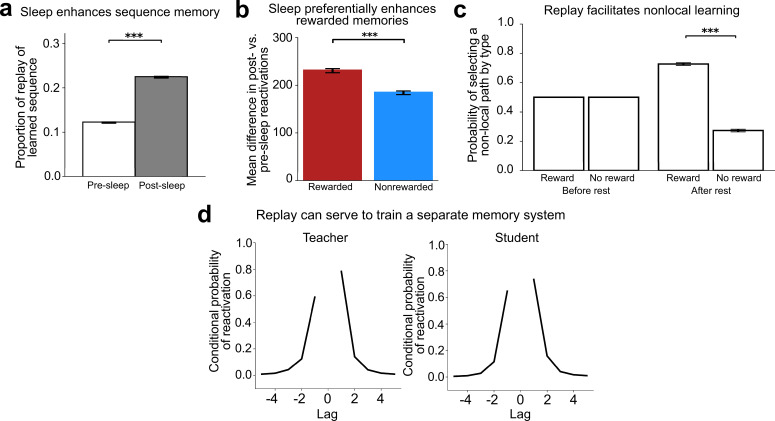
During rest and sleep, sequential neural activation patterns corresponding to awake experience re-emerge, and this replay has been shown to benefit subsequent behavior and memory. Whereas some studies show that replay directly recapitulates recent experience, others demonstrate that replay systematically deviates from the temporal structure, the statistics, and even the content of recent experience. Given these disparate characteristics, what is the nature and purpose of replay? Here, we offer a theoretical framework in which replay reflects simple context-guided processes that facilitate memory. We suggest that during awake learning, the brain associates experiences with the contexts in which they are encoded, at encoding rates that vary according to the salience of each experience. During quiescence, replay emerges as the result of a cascade of autonomous bidirectional interactions between contexts and their associated experiences, which in turn facilitates memory consolidation. A computational model instantiating this proposal explains numerous replay phenomena, including findings that existing models fail to account for and observations that have been predominantly construed through the lens of reinforcement learning. Our theory provides a unified, mechanistic framework of how the brain initially encodes and subsequently replays experiences in the service of memory consolidation.
§ The Valyu brief
Reading the full paper and taking notes. This takes a few seconds…
§ Ask this paper
Ask a question about this paper
Valyu reads the full text and answers from what the paper actually says.
Searching the other archives…