Squeeze-and-Excitation Enhanced Convolutional Neural Networks for Multi-class Pneumonia Classification on Chest Radiographs
Alexander Muacevic, John R Adler, Kian A Huang, Haris K Choudhary, Ashley Santiago, Neelesh S Prakash
Abstract
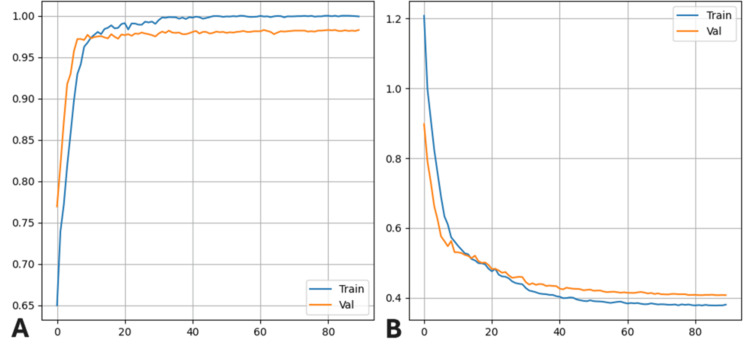
This study compared two convolutional neural network (CNN) architectures, ResNet50V2 and InceptionV3, each enhanced with squeeze-and-excitation (SE) attention mechanisms, for automated classification of chest X-rays into normal, pneumonia-bacterial, pneumonia-viral, and COVID-19 categories. A total of 9,208 posterior-anterior chest radiographs were analyzed, divided into training, validation, and test datasets under identical preprocessing and fine-tuning conditions. ResNet50V2-SE achieved a test accuracy of 98.18% and a macro-averaged area under the curve (AUC) of 0.9951, while InceptionV3-SE achieved 97.86% accuracy and an AUC of 0.9949. Class-specific evaluation showed that ResNet50V2-SE classified normal radiographs with perfect precision, recall, and F1-score (1.00). Pneumonia-bacterial images were classified with a precision, recall, and F1-score of 0.99, while pneumonia-viral and COVID-19 images reached F1-scores of 0.98 and 0.95, respectively. Comparable results were observed with InceptionV3-SE, achieving F1-scores of 1.00 for normal, 0.99 for pneumonia-bacterial, 0.97 for pneumonia-viral, and 0.95 for COVID-19. McNemar's test was performed to compare model performance on the same test set. ResNet50V2-SE was correct in eight cases where InceptionV3-SE was incorrect, whereas InceptionV3-SE was correct in two cases where ResNet50V2-SE was incorrect. The resulting χ² statistic was 0.1250 (p>0.05), indicating no statistically significant difference in classification performance between the two models. Both SE-enhanced CNN architectures demonstrated high accuracy and generalizability for differentiating among pneumonia subtypes on chest X-rays. These findings suggest that attention-augmented deep learning models may serve as effective decision-support tools in radiologic diagnosis, warranting further validation across larger and more diverse clinical datasets.
§ The Valyu brief
Reading the full paper and taking notes. This takes a few seconds…
§ Ask this paper
Ask a question about this paper
Valyu reads the full text and answers from what the paper actually says.
Searching the other archives…