Biomolecular condensates as cellular memory modules: Thermodynamic principles and plant stress adaptation
Sukhendu Maity, Panagiotis Nikolaou Moschou
Abstract
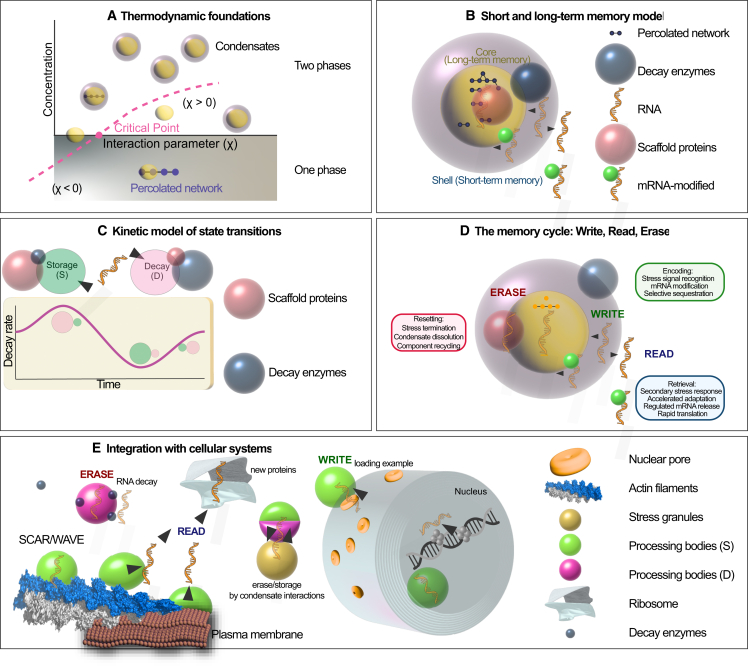
Organisms frequently encounter abiotic stresses such as drought, salinity, and extreme temperatures, requiring sophisticated adaptive mechanisms. Stress memory enables them to respond more efficiently to repeated environmental challenges by retaining information from prior exposures. Biomolecular condensates, dynamic, membraneless cellular assemblies formed by liquid-liquid phase separation, have emerged as crucial regulators of post-transcriptional gene expression, particularly in stress conditions. These condensates modulate RNA fate and translational repression by selectively storing and organizing key molecules in ways that may contribute to cellular memory mechanisms. Here, we explore the biophysical principles underpinning condensate formation and dynamics, with a focus on processing bodies (PBs) as potential cellular memory storage systems. We propose a framework for how PBs might integrate biochemical and biophysical signals to encode, maintain, and retrieve stress-responsive information, and discuss the evidence supporting their role in coordinated stress responses and adaptive resilience in plants.
§ The Valyu brief
Reading the full paper and taking notes. This takes a few seconds…
§ Ask this paper
Ask a question about this paper
Valyu reads the full text and answers from what the paper actually says.
Searching the other archives…