An Inverse Problem for a Fractional Space–Time Diffusion Equation with Fractional Boundary Condition
Rafał Brociek, Agata Wajda, Christian Napoli, Giacomo Capizzi, Damian Słota, Teddy Craciunescu, Andrea Murari, Ivan Wyss
Abstract
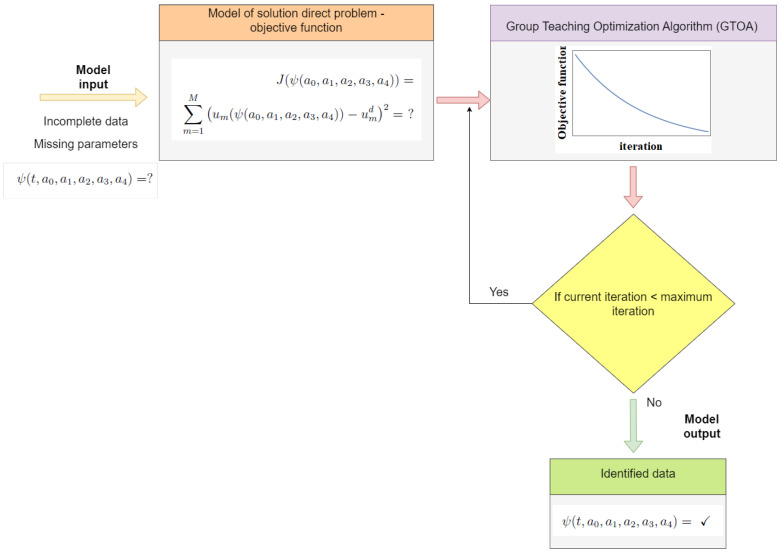
This article presents an algorithm for solving the direct and inverse problem for a model consisting of a fractional differential equation with non-integer order derivatives with respect to time and space. The Caputo derivative was taken as the fractional derivative with respect to time, and the Riemann-Liouville derivative in the case of space. On one of the boundaries of the considered domain, a fractional boundary condition of the third kind was adopted. In the case of the direct problem, a differential scheme was presented, and a metaheuristic optimization algorithm, namely the Group Teaching Optimization Algorithm (GTOA), was used to solve the inverse problem. The article presents numerical examples illustrating the operation of the proposed methods. In the case of inverse problem, a function occurring in the fractional boundary condition was identified. The presented approach can be an effective tool for modeling the anomalous diffusion phenomenon.
§ The Valyu brief
Reading the full paper and taking notes. This takes a few seconds…
§ Ask this paper
Ask a question about this paper
Valyu reads the full text and answers from what the paper actually says.
Searching the other archives…