Developing a Quality Evaluation Index System for Health Conversational Artificial Intelligence: Mixed Methods Study
Amy Schwartz, Matthew Balcarras, Jari Haverinen, Rong Yin, Weizhen Liao, Meng Li, Chengyu Ma, Youli Han, Dan Wang, Haopeng Liu, Yi Wang, Zijie Feng, Huichao Wang, Yiru Guan
Abstract
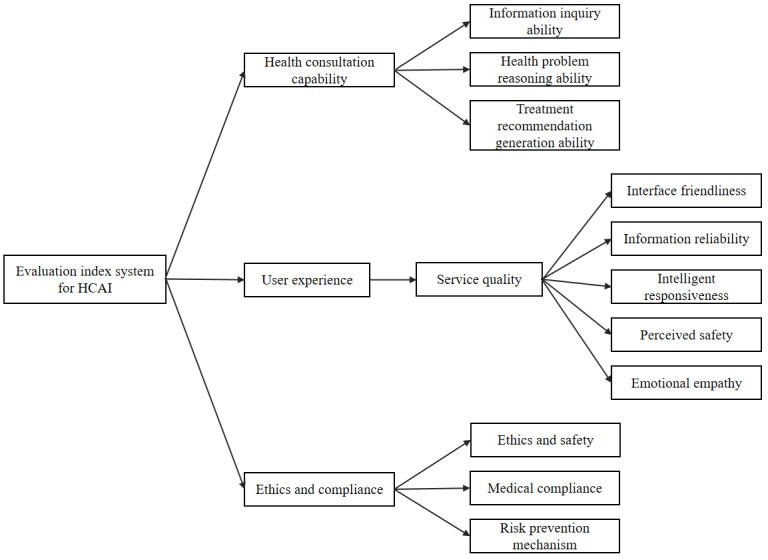
Background Effective communication is fundamental to health care; however, demographic transitions and a widening global health workforce gap are intensifying the imbalance between service demand and resource supply. Health conversational artificial intelligence (HCAI) based on large language models offers a potential pathway to improve the accessibility and personalization of care. Nevertheless, the lack of a rigorous, user-centered evaluation framework limits the systematic assessment of HCAI quality, raising concerns regarding safety, reliability, and clinical applicability. Objective This study aims to establish a scientific and systematic quality evaluation index system for HCAI, providing both a theoretical foundation and a practical tool for the assessment and optimization of HCAI. Methods Based on a literature review, industry standards, and expert group discussions, a preliminary framework for the index system was established. Two rounds of Delphi expert consultations were then conducted to collect expert opinions. The analytic hierarchy process (AHP) was applied to assign weights to indicators at each level, and the final content and structure of the index system were determined. Results Both rounds of expert consultation achieved a 100% response rate. The authority coefficient of the experts was 0.84 in both rounds. Kendall W coefficient ranged from 0.14 to 0.20 in the first round and from 0.13 to 0.17 in the second round, with all values showing statistical significance (round one: importance P<.001, feasibility P<.001, sensitivity P<.001; round two: importance P=.001, feasibility P<.001, sensitivity P=.001). The final HCAI quality evaluation index system consisted of 3 primary indicators, 7 secondary indicators, and 28 tertiary indicators. According to AHP weight calculations, the primary indicators were ranked in descending order as follows: ethics and compliance (0.4781), health consultation capability (0.4112), and user experience (0.1107). Conclusions The evaluation index system constructed in this study demonstrates scientific validity and practical relevance.
§ The Valyu brief
Reading the full paper and taking notes. This takes a few seconds…
§ Ask this paper
Ask a question about this paper
Valyu reads the full text and answers from what the paper actually says.
Searching the other archives…