Data-driven ANN-based visual decoding enables unsupervised functional alignment
Xin-Ya Zhang, Hang Lin, Zeyu Deng, Markus Siegel, Earl K. Miller, Gang Yan
Abstract
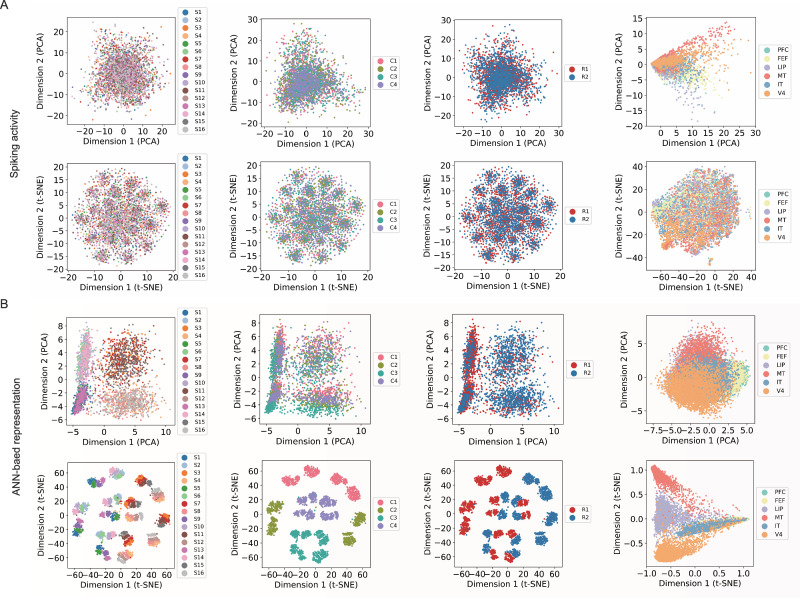
Artificial neural networks (ANNs) offer a data-driven approach to reveal brain regional functions without explicit supervision. Here, we demonstrate that an ANN trained to decode visual stimuli from multi-unit spiking activity in monkeys, can not only reconstruct complex and dynamic scenes, but also spontaneously align with canonical cortical visual functions. Without any region-specific functional priors, the model identifies key brain areas associated with shape, color, and motion processing. We provide strong evidence that, despite low train-test dataset correlation at the recording-site level, the ANN-based model is able to learn task-relevant representations embedded at a high-dimensional population level and achieve reliable decoding performance. Furthermore, by inverting the architecture and retraining, we show that the same network can predict region-specific spiking patterns from visual input, indicating a reciprocal relationship between encoding and decoding. These findings shed light on ANN-based visual decoding as a powerful framework for unsupervised functional alignment in neural systems.
§ The Valyu brief
Reading the full paper and taking notes. This takes a few seconds…
§ Ask this paper
Ask a question about this paper
Valyu reads the full text and answers from what the paper actually says.
Searching the other archives…