A comparative analysis of predictive models of morbidity in intensive care unit after cardiac surgery – Part II: an illustrative example
Gabriele Cevenini, Emanuela Barbini, Sabino Scolletta, Bonizella Biagioli, Pierpaolo Giomarelli, Paolo Barbini
Abstract
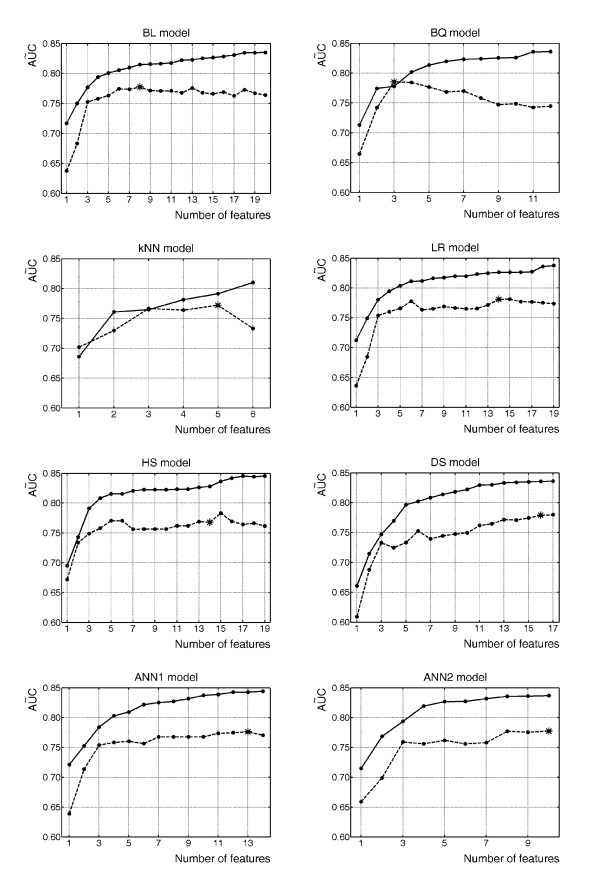
'Bonizella Biagioli' 'Pierpaolo Giomarelli' 'Paolo Barbini'] Background Popular predictive models for estimating morbidity probability after heart surgery are compared critically in a unitary framework. The study is divided into two parts. In the first part modelling techniques and intrinsic strengths and weaknesses of different approaches were discussed from a theoretical point of view. In this second part the performances of the same models are evaluated in an illustrative example. Methods Eight models were developed: Bayes linear and quadratic models, k-nearest neighbour model, logistic regression model, Higgins and direct scoring systems and two feed-forward artificial neural networks with one and two layers. Cardiovascular, respiratory, neurological, renal, infectious and hemorrhagic complications were defined as morbidity. Training and testing sets each of 545 cases were used. The optimal set of predictors was chosen among a collection of 78 preoperative, intraoperative and postoperative variables by a stepwise procedure. Discrimination and calibration were evaluated by the area under the receiver operating characteristic curve and Hosmer-Lemeshow goodness-of-fit test, respectively. Results Scoring systems and the logistic regression model required the largest set of predictors, while Bayesian and k-nearest neighbour models were much more parsimonious. In testing data, all models showed acceptable discrimination capacities, however the Bayes quadratic model, using only three predictors, provided the best performance. All models showed satisfactory generalization ability: again the Bayes quadratic model exhibited the best generalization, while artificial neural networks and scoring systems gave the worst results. Finally, poor calibration was obtained when using scoring systems, k-nearest neighbour model and artificial neural networks, while Bayes (after recalibration) and logistic regression models gave adequate results.
§ The Valyu brief
Reading the full paper and taking notes. This takes a few seconds…
§ Ask this paper
Ask a question about this paper
Valyu reads the full text and answers from what the paper actually says.
Searching the other archives…